
Mission – using subjective identification techniques on Streamline Charts at the start of 12-hourly rainfall period recorded in 1966-2012 with verification over an outside sample dataset in 2013-2021 at Hong Kong
Charles Luk
The author is also the owner of https://contourtechnique.ca/2026/01/07/a-fantastic-approach-for-easy-contour-drawing-and-simple-high-low-labeling/
Update: 23 August 2025 -After hand-drawn streamline analysis being applied on the 200 hPa wind chart, the behavior type in the first 12-hourly period of the record-breaking case(refer posting 13 August 2025) was amended.
Posting: 13 August 2025 -Recurrence of Cat 1 Case 5(spell) leads to record-breaking 24-hr Rainfall of 391.4mm in Hong Kong between 041200GMT to 051200GMT.
Update: 29 July 2025 – Focus is made on the most remarkable, challenging, inspiring, frequently occurred(7 times) and highly intensive behavior in Category 3’s Type 5 Anticyclone on mainland China with its eastern ridge extension 1) beyond the East China coast and 2) northeastern portion being shrunk or penetrated by vertical trough.
Posting: 14 July 2025 – Category 3 behaviour presentation is revised to reflect the change in the title of the current study project.
First posting – 10th January 2021
ABSTRACTS
Observations show that each occurrence of 12-hourly extreme rainfall in Hong Kong is directly related to the synoptic features which appear on the 200 hPa chart at the start of the 12 hours. Successive occurrences over 24 hours form an extreme rainfall spell under one synoptic situation dominated by a disturbance affecting Hong Kong.
INTRODUCTION : An upper-air disturbance detection Model is formulated from 200 hPa synoptic developments observed on the latest 2 streamline charts preceding every heavy rainstorm case in 1966-2012 in Hong Kong. An attempt is made to generalize the concept of the techniques in the model for other subtropical regions. Rainstorm extremes are defined as any occurrence of 12-hourly rainfall amounts of 80 mm measured at H+12 up to a maximum of approximately 300 mm and above. The approach is through systematic identification and classification of activities or events (hereafter called behavior) observed from two latest streamline charts at H -12 and H -0 preceding storms. The NCEP/NCAR Annual Reanalysis Dataset of the National Weather Service forms the base of data in this study which is conducted by a VC++ software program running on the Microsoft Windows 10 platform.
This document presents a sample from 29 observations each with a separate 200 hPa behavior pattern involving storm occurrence (ranging between 83.0mm and 295.7mm with a mean of 184.9 mm). There are 37 real behavior types (plus 2 from virtual behavior mentioned below) and 210 cases in the 47 years. The 29 behavior types though constitute only 78% in types, encompass 189 observations which constitute 90% of the total occurrences (in other words, with the remaining 12 behavior types accounting for 21 observations). The 29 cases with 6 at the top of the intensity list and 7 others comprise 13 (with mean = 229.9mm) out of a total of 17 historical cases which are greater or equal to 200mm.
As a word of caution, since surface synoptic features such as tropical cyclones and easterly waves can play a role in modulating certain types of upper-air behavior, the resulting behavior types could therefore be specific to the regions in which these features can prevail. In such circumstances, each meteorological office should develop own model suitable for its region.
The next question is how big a historical dataset of behavior is considered large enough to meet one’s performance expectation. Although no dataset is complete and exhaustive of all behavior, if throughout a long (say 50 years) record period, there is no behavior entry occurred just once (meaning a match from the pool of observed behavior is always found for each entry), one can be fairly confident that the behavior dataset is highly ‘self-contained’. But strictly speaking, this is not a reasonable requirement as long as each unique behavior occurrence is dynamically justified. In building the detection model from historical records, we have to assign for each rainstorm occurrence a behavior type observed on the 200 hPa analysis. If no behavior type that can best (meaning concisely, precisely, and completely) describe the dynamic of the situation exists, one can either expand the definition on some existing behavior type or define a new type. It is critical for behavior type to be defined correctly to avoid 1) introduction of fake behavior type into the model due to misperception or misinterpretation of the situation and 2) collateral damage which compromises the addition of a new proper type into the model. Sometimes, a situation can meet criteria of more than one type of behavior, precedence should be given to assigning the type as one which is historically most weather destructive among types.
The following descriptions and charts contain examples of behavior with detection guidelines used to uncover them. The chart time at the top refers to the right-hand chart at Hour +0. The rainfall amount at Hours +12 is displayed at the top line of each pair of charts. (for reference, the left-hand chart time at Hour -12 is displayed at the bottom left corner inside the chart). Readers are encouraged to practice behavior assignment before advancing the baseline of the chart beyond the bottom edge of the browse screen to read the type description there.
Each case listed below carries a case number. If in some case (actually 4) the case number has the letter ‘a’ subscript, it means that it is a variation from the non-subscript case (both of which apply to the same meteorological feature) with rarer occurrence but worse weather consequence.
ANALYSIS From records, rainstorms not preceded by behavior type on 200 hPa analysis could happen for a handful of cases, suggesting that behavior type is not a necessary condition. But research shows under these situations, each case would exhibit either one of the 2 aspects of vertical velocity activity at 850 hPa level. By regarding such phenomena as virtual behavior, we can declare behavior (either real or virtual) to be a necessary condition for extreme rainstorm occurrence. On the other hand, past statistics show not all behavior occurrences at 200 hPa were succeeded by heavy rainstorm, behavior is therefore not a sufficient condition. What can we do, in future practice, to trust any observed behavior could eventually turn up sufficient? Instability evidence on the surface pressure chart from each past rainstorm record is what we can resort to. In the first place, none of the 210 storms was associated with stable surface situation. Unstable surface situations amount to 168 (80%) and can be used as a good suggestion to support behavior found on 200 hPa. For the remaining 20%, where the surface chart shows only mild or even neutral condition (e.g. slack trough or flabby/stationary low or trough/low absent in proximity) which are not favorable for heavy rainstorm development, supporting evidence has to be sought from the 850 hPa level. In the presentation follows, depending on where greater instability observed, either the surface or 850 hPa chart at the date-time of the behavior case could be selected in the display.
SYNOPTIC EVENTS Disturbance can last over multiple (up to 3) 12-hourly periods in a rain spell. In the following, whenever any presented behavior type falls within a spell, all preceding or succeeding types occurring in that spell are included in the display. The 175 rainstorms lasting 1, 2, or 3 periods are composed of 147(84%) single period cases, 21(12%) double period cases, and 7(4%) triple period cases (which add up to 147+21X2+7X3= 210 period cases). This document includes 8 of the 21 double-period spells and 4 of the 7 triple-period spells with the most remarkable rain-bearing behavior type dated and referred to as the ‘featured’ type. In the study of a spell, instead of just listing it in a series of unrelated, discrete, and standalone behavioral occurrences, walking over each spell on an eventful scenario will shed light on the synoptic perspective involved. In short, an event is a composition of atmospheric activities from behavior combined.
Following are 3 example events. The first event is the formation of an atmospheric feature (e.g. easterly wave) appearing under one of the three situations: 1) A feature is formed at a great distance from Hong and takes a long time to complete its approach. 2) the feature that forms in the vicinity might show a rudimentary stage which lengthens its time of weather impact on the station, and 3) the feature that occurs with great intensity or size extends its subsequent evolution in degeneration or further development to a new feature. The second event is that an atmospheric process may persist for a long time or accompany further development. The last(third) event is atmospheric features(such as trough and anticyclone) may take a long while to finish their interaction. For example, an anticyclone expands against a cyclonic or easterly wave to its south for a long duration or a westerly trough takes a long distance to complete its passage. A slow travelling trough across the East China coast may trigger a prolonged anticyclonic expansion over Hong Kong. In other words, activities occurring in a spell can be combined as one single synoptic event of feature(easterly wave) birth, feature(ridge) evolution or feature movement ( trough passage). Synoptic event descriptions will be stated in a tagline at the start of each ‘spell’ case.
PRESENTATION Behavior types are classified under 3 categories. The first category (roughly 23% with a mean of 136.7mm) can be called the ‘what’ category because each behavior type can be easily identified from familiar/well-known meteorological feature objects observed on streamline charts. These include various waves in the easterly (such as large vertical wave, easterly wave, and tilted easterly wave), horizontal-axis trough, and strong out flowing anticyclone or large/small cyclone.
The focus is on the searching of all these features as well as determination of their genesis, locations relative to the station, tracks/movements, intensity, transformation to or interaction with other features within the same category. Behavior which ‘brought about’ extreme rainfall mostly came from behavior types in this category.
Category one behavior All cases in Category 1 occur at the height of summer months (August and September) in association with passage of severe/extreme Tropical Cyclone the occurrence of which in Hong Kong are confined to Category 1 in this study.
Cat 1 Case 1: 182mm – 97082200
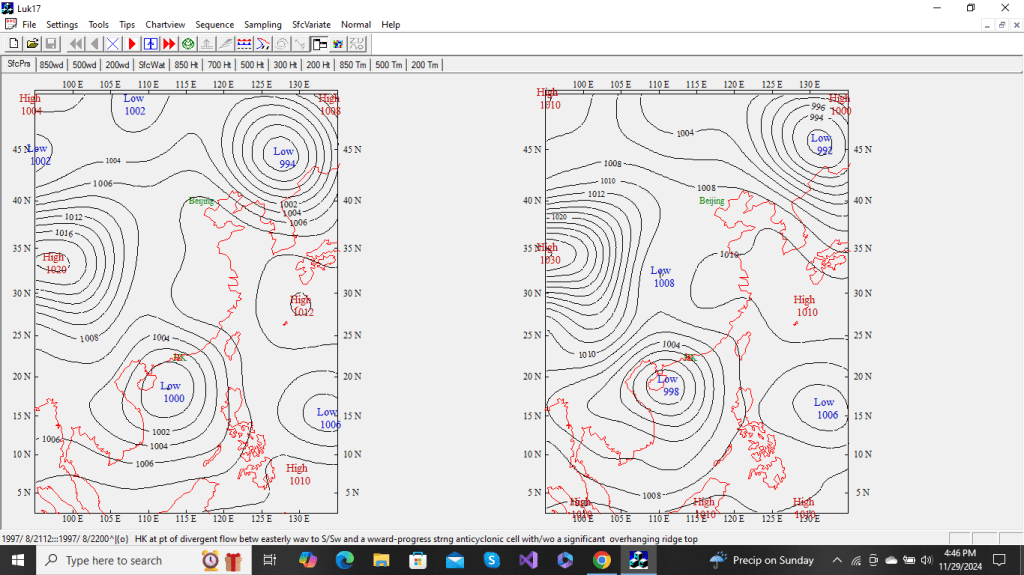
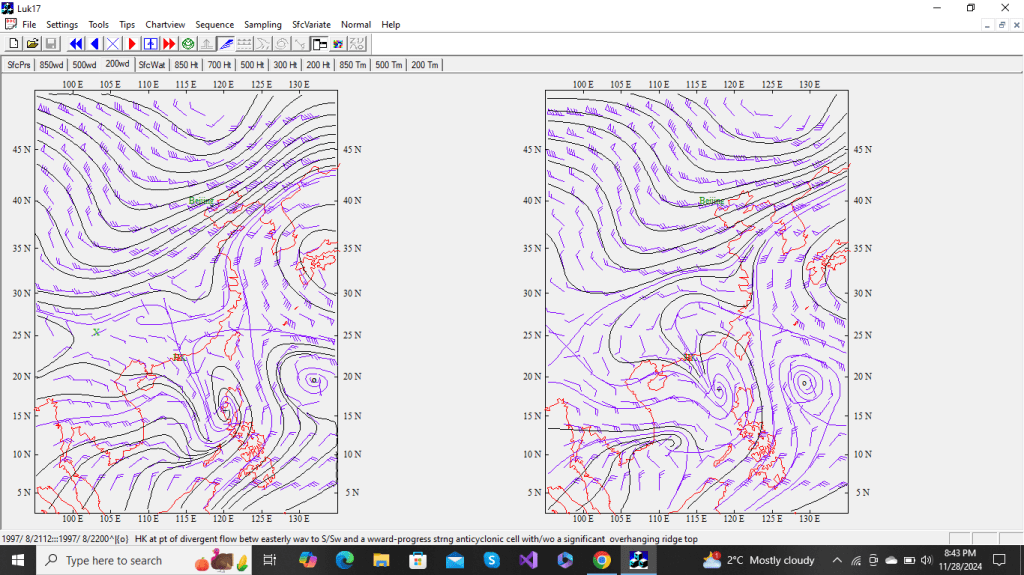
Synoptic scenario : At H-12, An easterly-wave/anticyclonic-cell pair lies to the south of HK over the middle part of the South China Sea.
Cat 1 Case 2: 201.7mm – 79080200
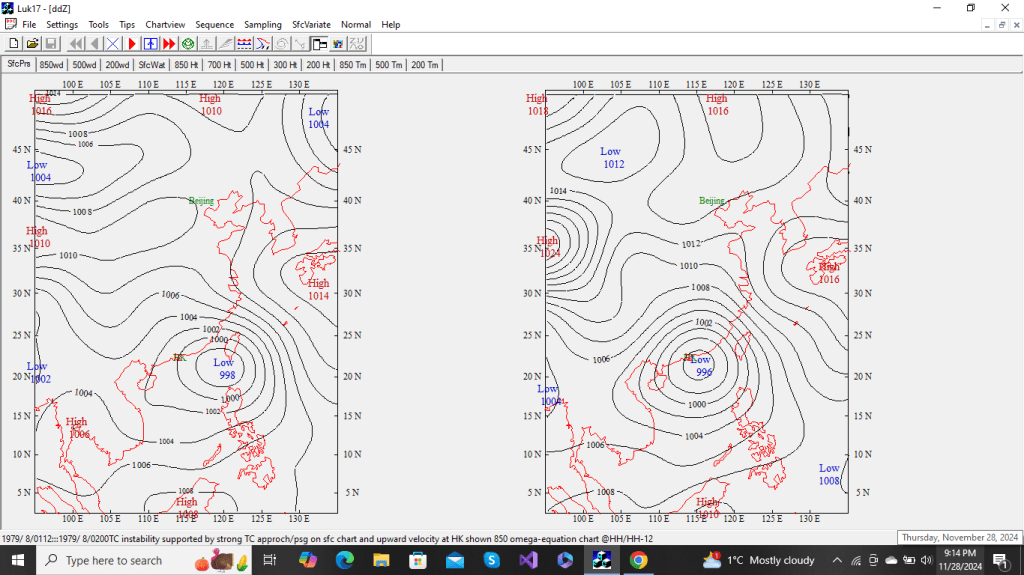
Synoptic scenario: HK lies in the easterly zonal flows under big anticyclonic ridge across Central China with a curly shallow easterly wave to east.

Cat 1 Case 3: 09091412 – 146.7mm
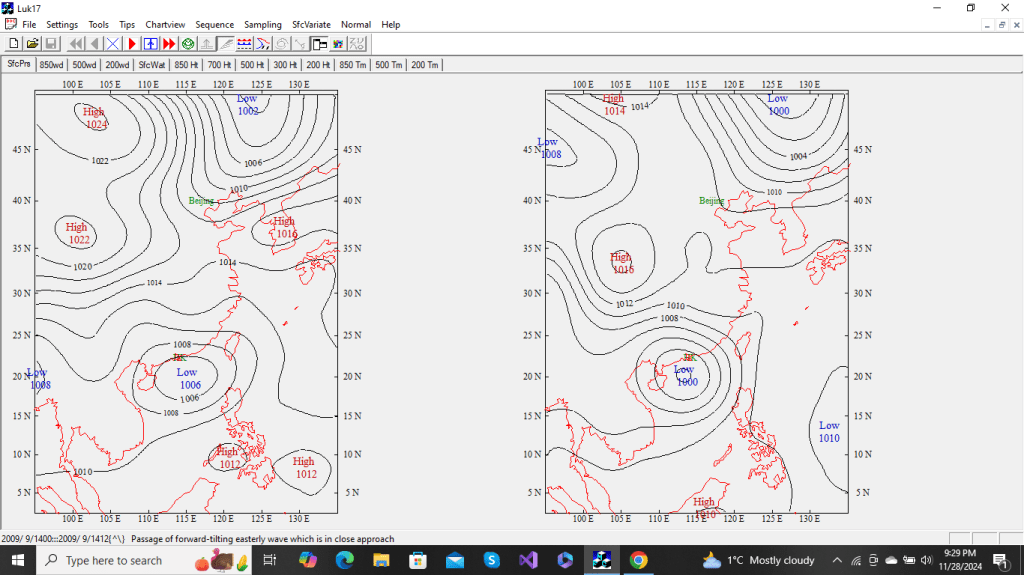
Synoptic scenario: HK lies under big anticyclonic ridge across Central China with tilted easterly wave passing northern Luzon.
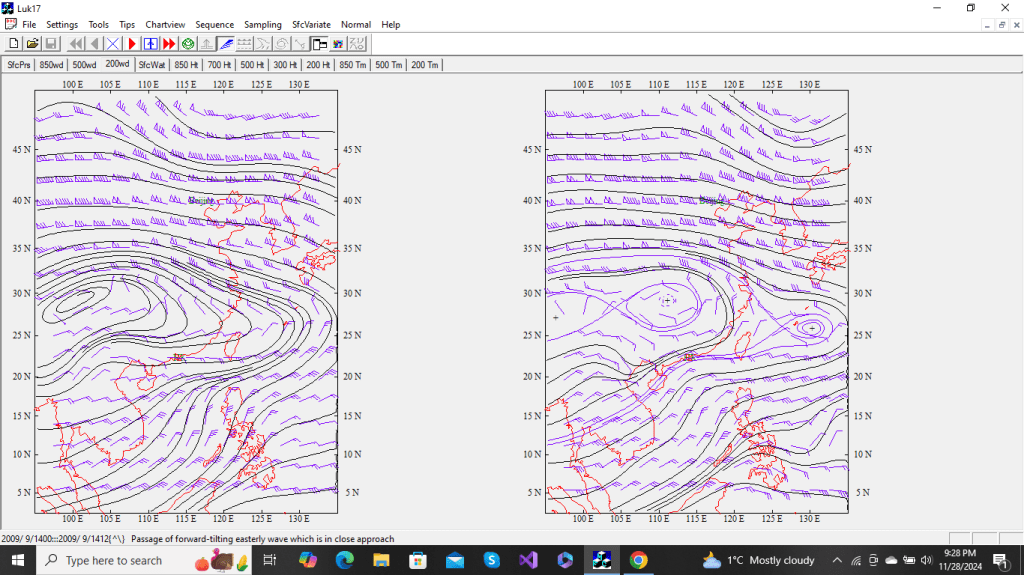
The next 2 cases relate to easterly waves:
Cat 1 Case 4(spell)Target H+0
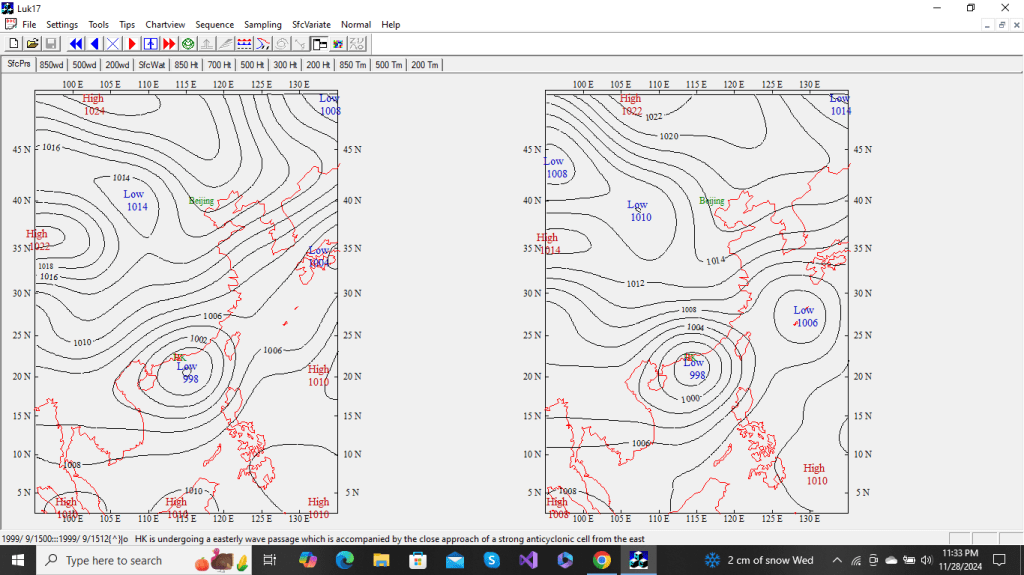
Synoptic scenario – The southeast extension of the big South China ridge over Luzon Strait is intensified by the westerly wave passage over the East China Sea:
———————————————————(162.6mm) 99091512TargetH+0
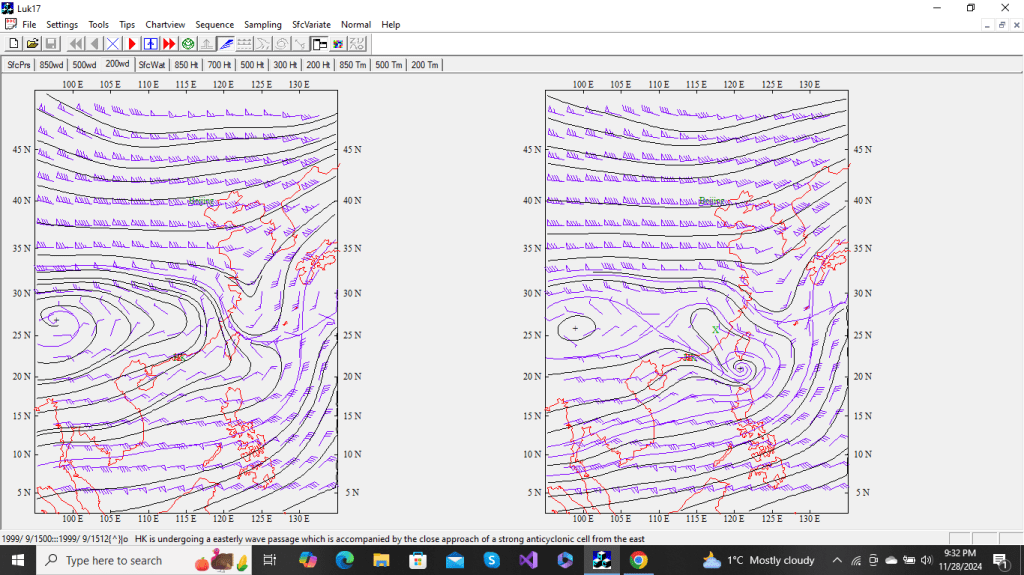
(88.3mm)
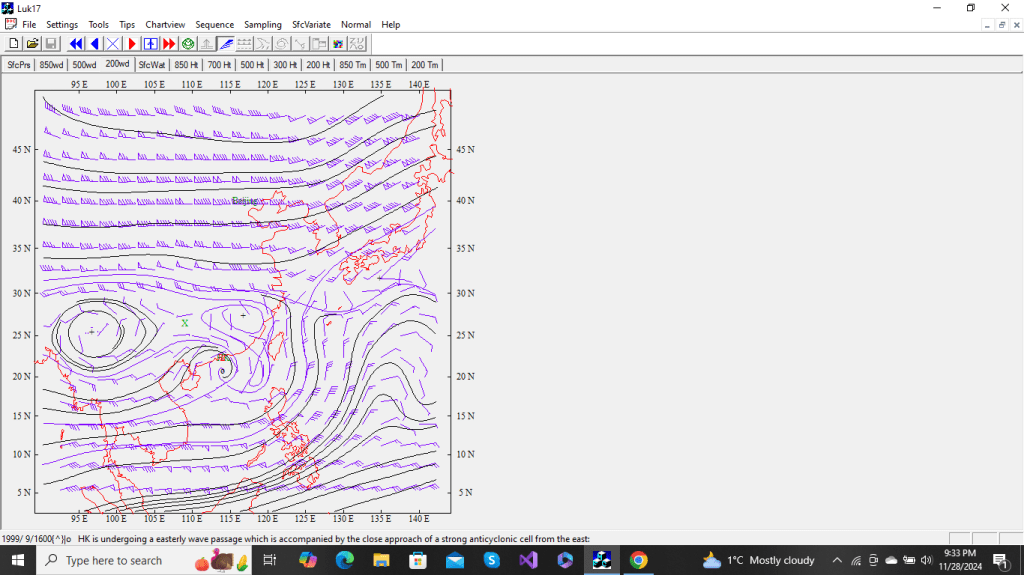
End of spell
Cat1 Case 4a (spell)Target (H+12)
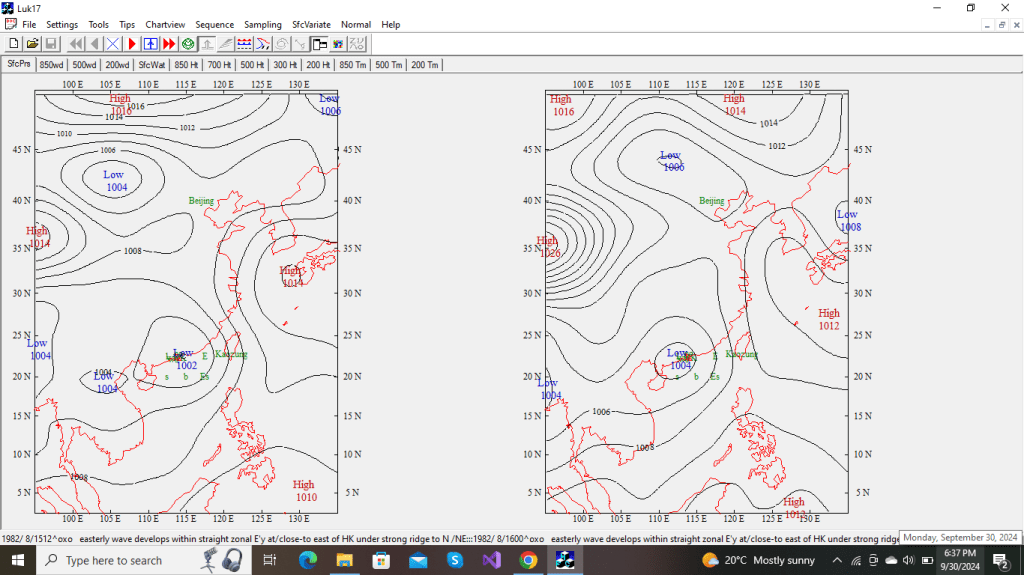
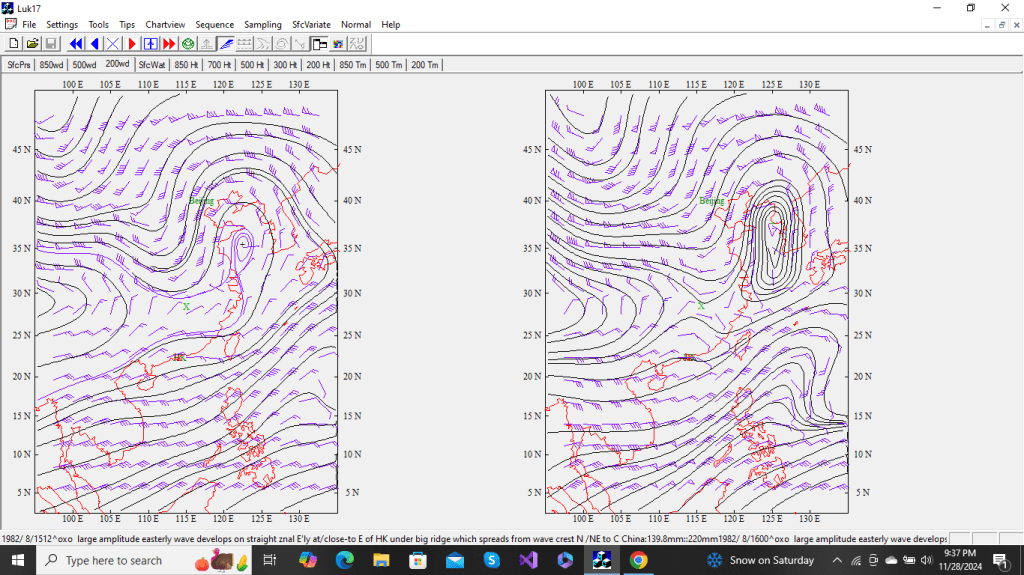
Synoptic scenario – Shallow wave forms within the easterly zonal flow under a large East China anticyclone.
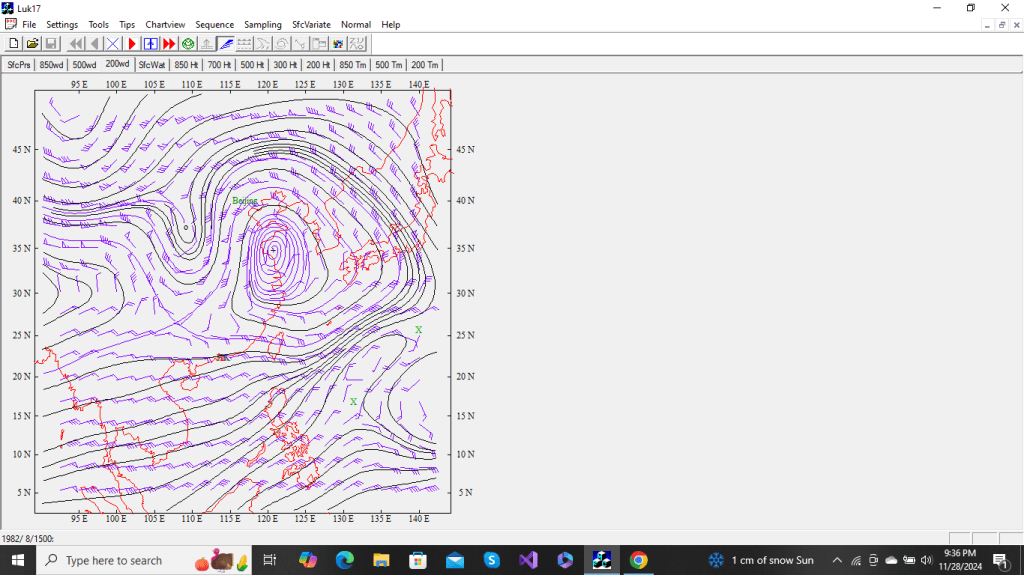
(139.8mm)——————————————–(220mm) 82081600TargetH+12
The next 2 cases relate to outflowing cyclone:
Cat 1 Case 5(spell)Target H+12
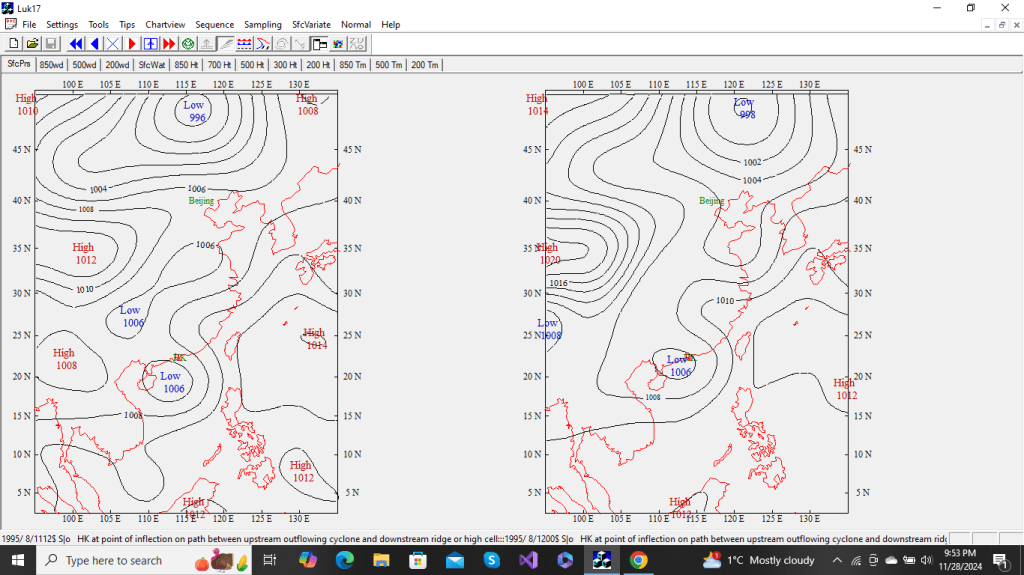
Synoptic scenario – Excitation of a small cyclone-anticyclone pair at H-12 close to the west of HK produces an evolution involving outflowing cyclone on top and anticyclonic cell at the bottom:
——————————————————–(90.2mm)95081112H+0
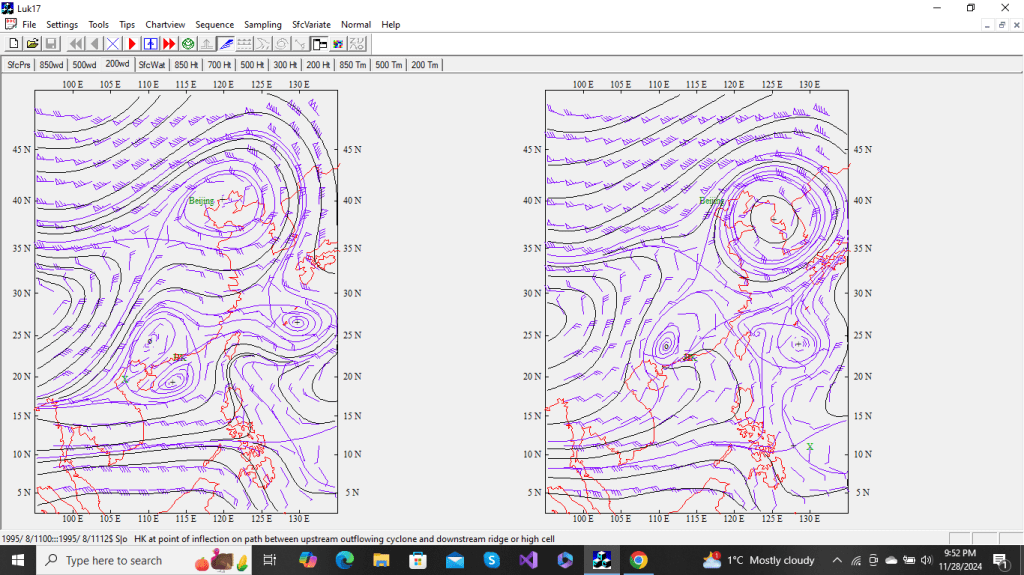
(128.8mm) 95081200TargetH+12————————(144.9mm)95081212H+24
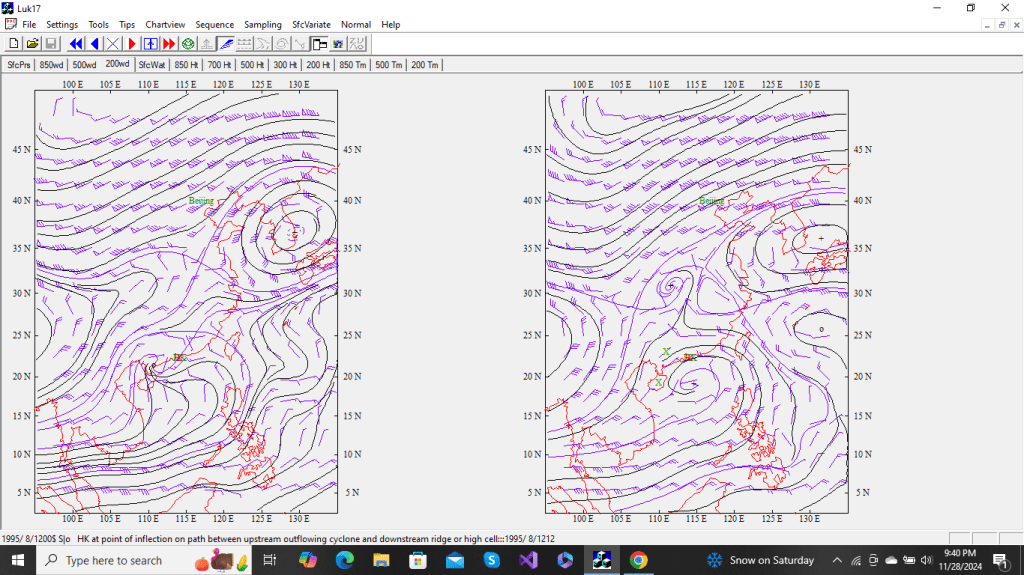
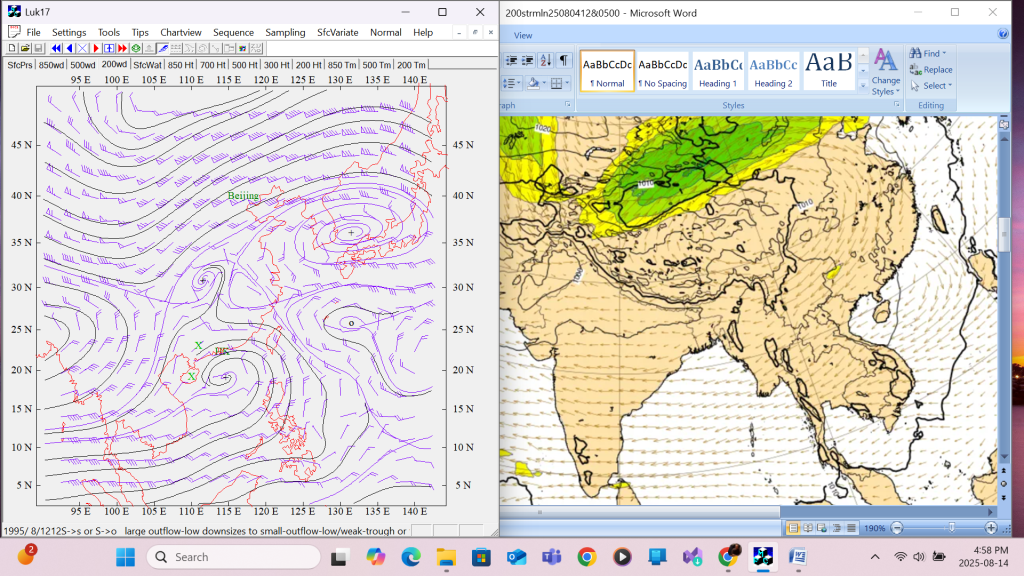
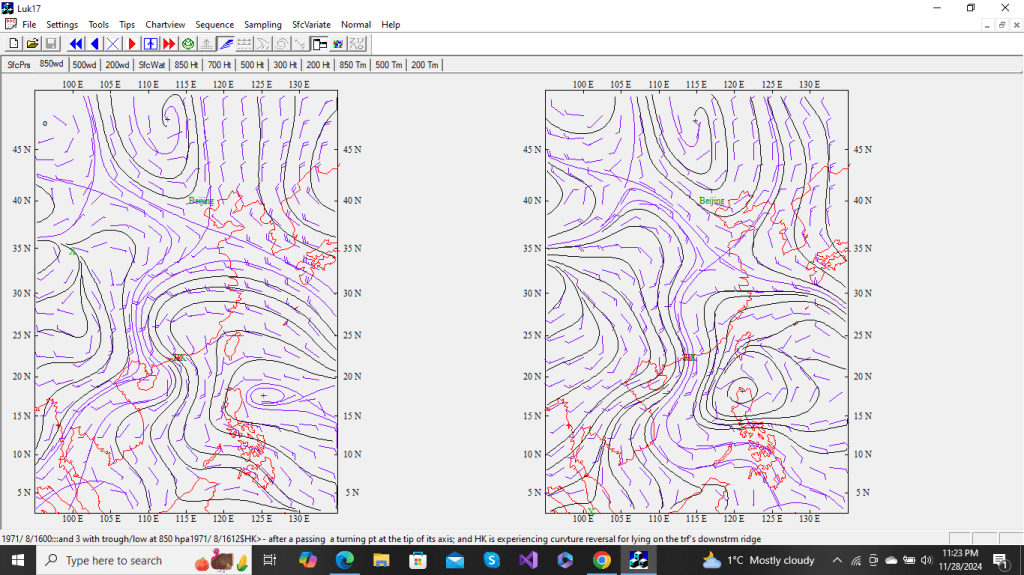
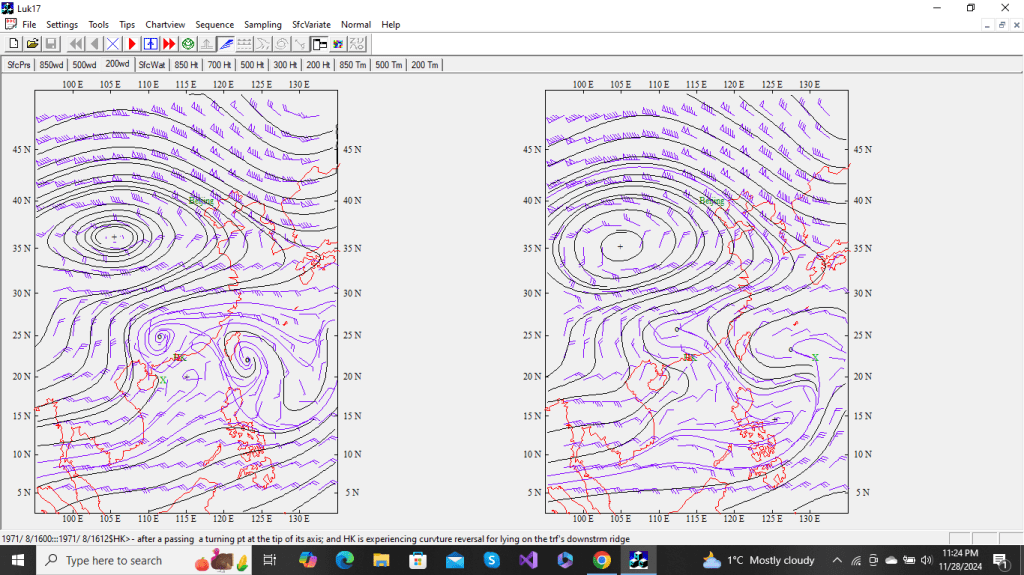
With the auspices of ECMWF web’s actual data display the following demonstrates: Recurrence of Cat 1 Case 5(spell) leads to record-breaking 24-hr Rainfall of 391.4mm in Hong Kong from 2025 August 041200GMT to 051200GMT.
Below RHS is the first-period case (179.6mm)25080412, it recurs LHS (128.8mm)95081200 which is Cat 1 Case 5 H+12 above at a stronger magnitude with HK at the point of inflection.
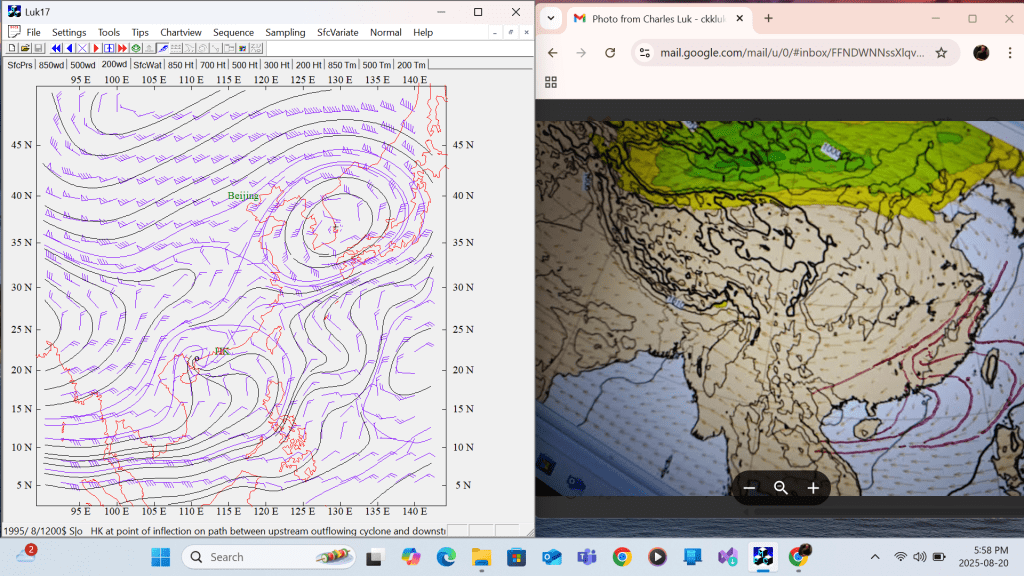
With (179.6mm)25080412 as H-12 (RHS above)——-(below) (211.8mm)25080500 H+0 posts the second-period case.
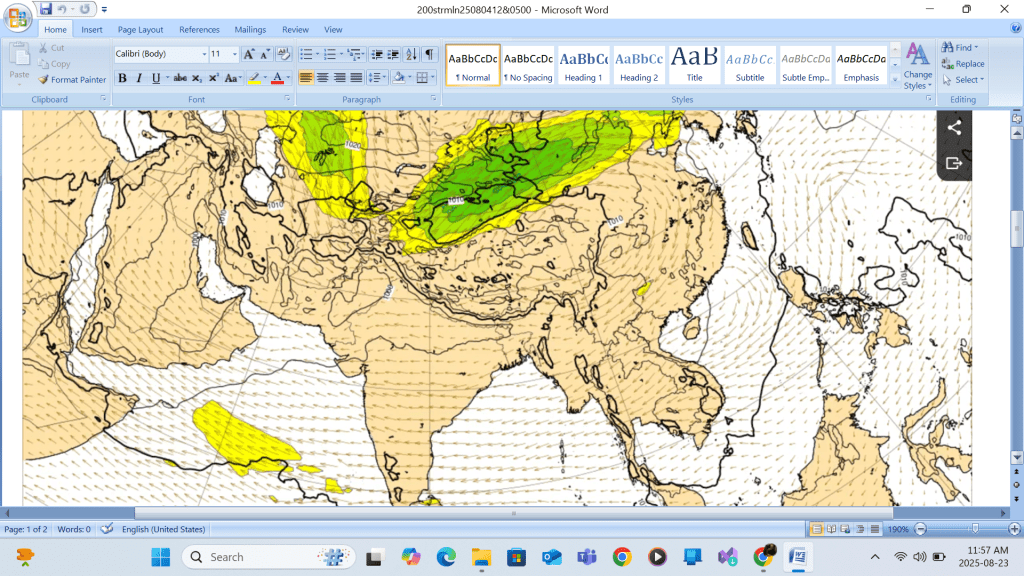
End of spell.
Cat 1 Case 5a (spell)Target H+12
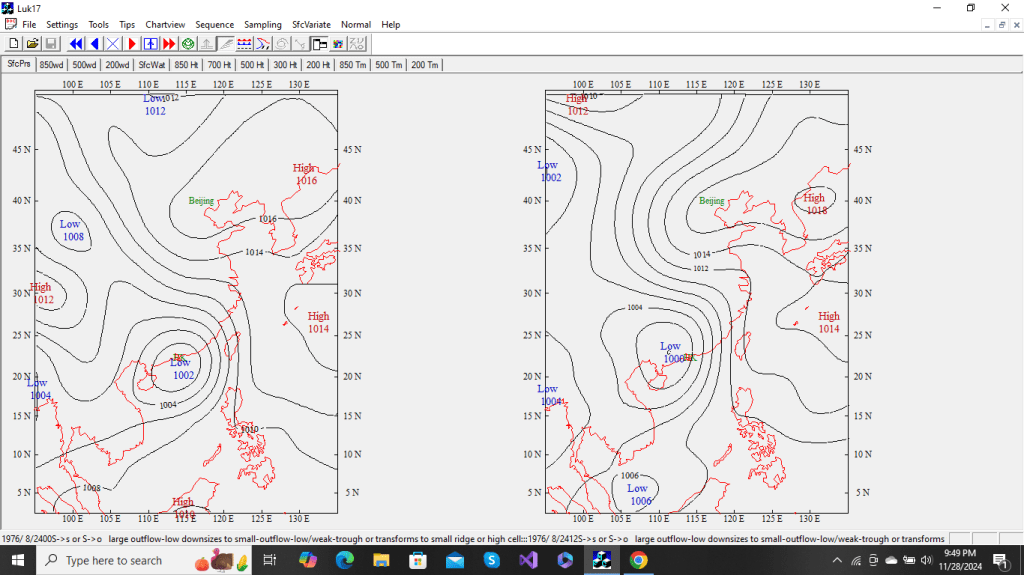
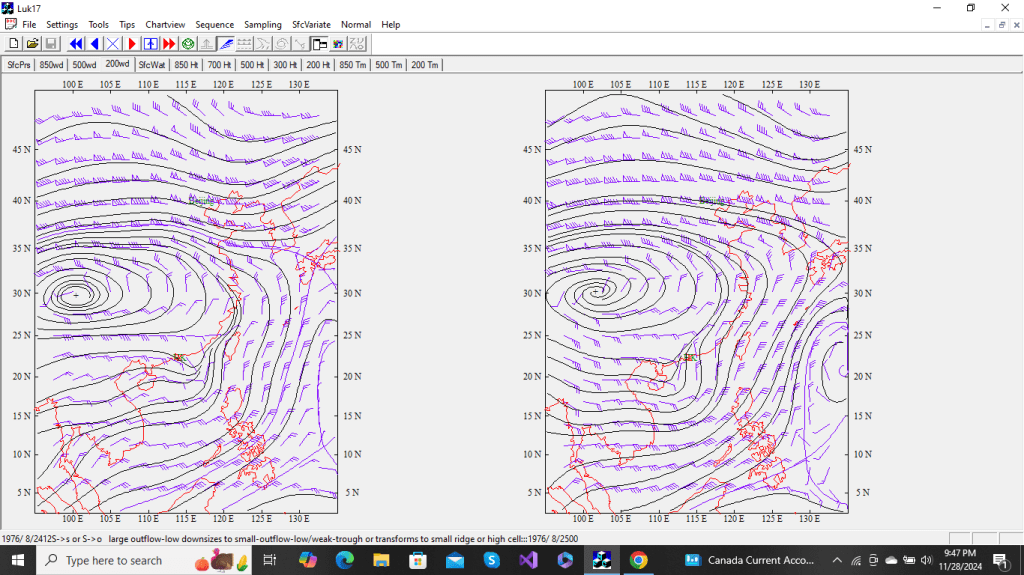
Synoptic scenario – Large outflowing cyclone near HK is upward degenerated eventually to a horizontal ridge in situs:
——————————————————–(92mm)H+0
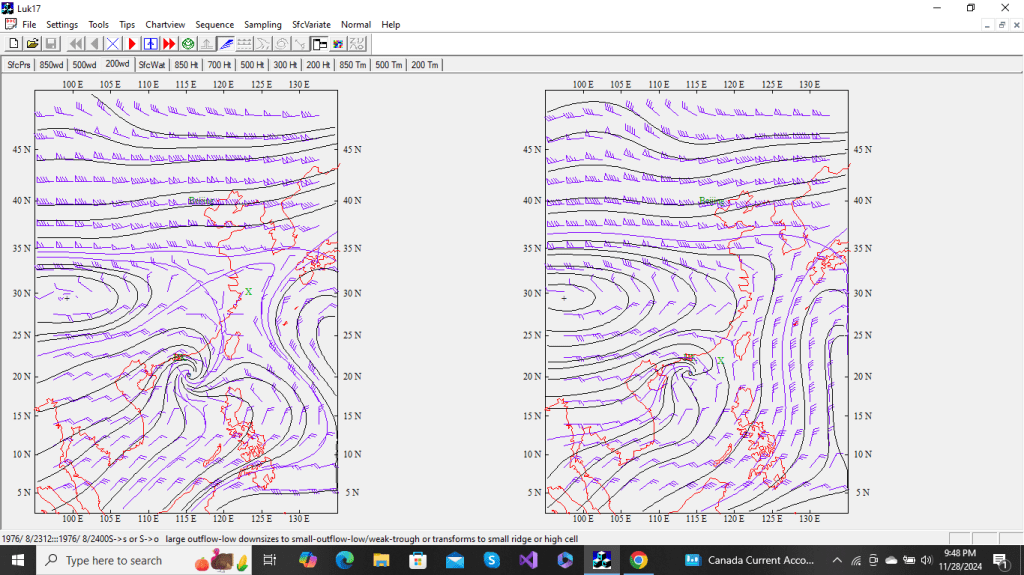
(274.7mm) 76082412TargetH+12————————–(92.2mm)
End of spell
Category two behavior The behavior types in the second category which constitutes a very significant part (roughly 41%) of HK’s past extreme weather situations could be called the ‘where’ category because they are easily located from a) horizontal/tilted ridge resting on own/adjacent 2&1/2 degree latitude band (row) near HK or b) southwest China’s semi-rhombus-shaped ridge anchored to the west of HK. Each type is involved with the south-to-own or north-to-own row displacement or vice versa happening to a ridge segment on the east, west or both sides of Hong Kong. A common observation is through using a ridge axis clockwise or counterclockwise rotation. Such rotation is hinged on a pivotal ridge or anticyclone center in a specific neighborhood and would end up with the axis closer to or further away from Hong Kong. Observations also include tilting as applied to ridge cell hinged near Hong Kong extending east-northeast, with winds veering along the top line as they get further away from Hong Kong. Other observations include dipping as applied to ridge hinged west-northwest of Hong Kong extending to Hong Kong.
Since in some cases, the qualifying ridge mentioned above could match more than one behavior type description, it is advisable to determine type in the following order of precedence: 1) having cyclonic upstream flow (allocating it as a type in the first category), 2) ridge-axis row-position shift occurring in semi-rhombus shaped standing ridge, 3) making row displacement by a segment on either side of HK, 4) exhibiting close/distant axis tilting or dipping, and 5) ridge width shrinking (i.e. wind barbs undergoing angle sharpening alongside ridge axis) on north/own row. Behavior type belonging to this category also includes northeast/southwest ridge extension/intrusion to HK from medium-sized anticyclone to the southwest/northeast of HK.
Behavior types in this category occur in late summer except on a special form (semi-rhombus-shaped) of the ridge which occurs in May or June.
Following 2 cases occur in late summer (October) followed by 1 case in September.
Cat 2 Case 1(spell)Target H+0
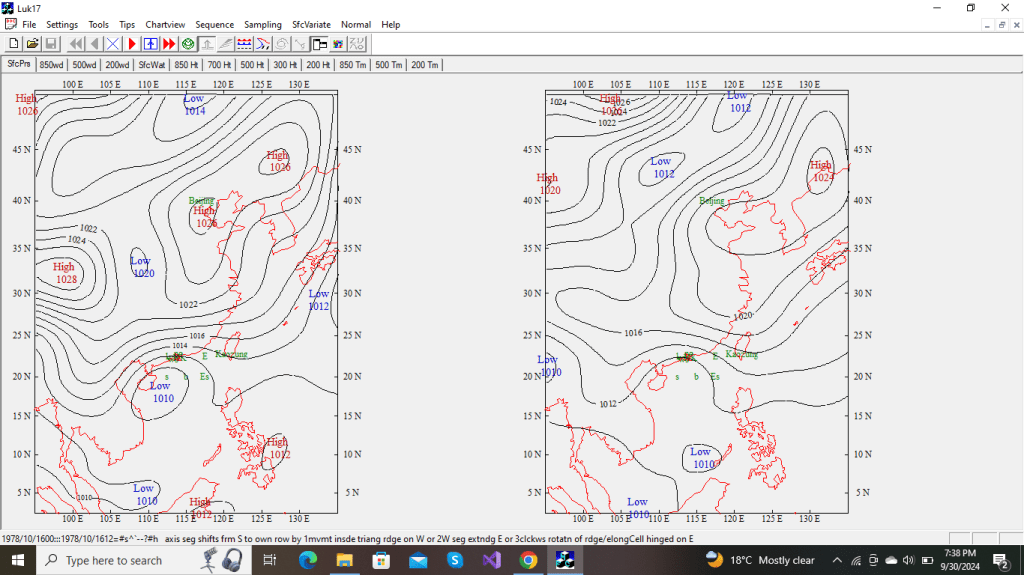
Synoptic scenario – On the west extension of a big horizontal West Pacific anticyclone, curvature of ridge axis at HK is enhanced by axis rotation(current case) or elongation(second example case below) :
———————————————————(224.5mm) 78101612TargetH+0
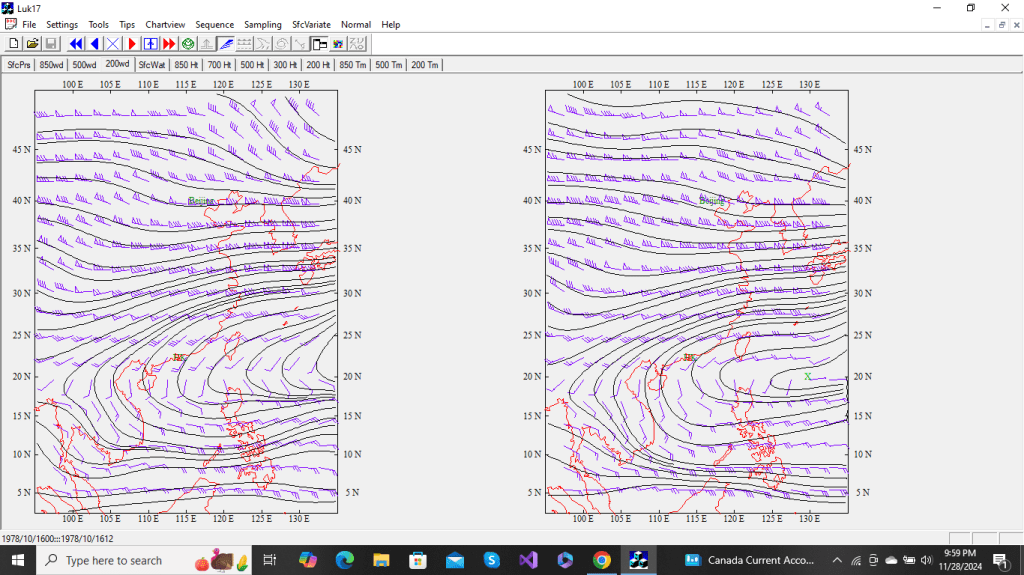
(121.3mm)
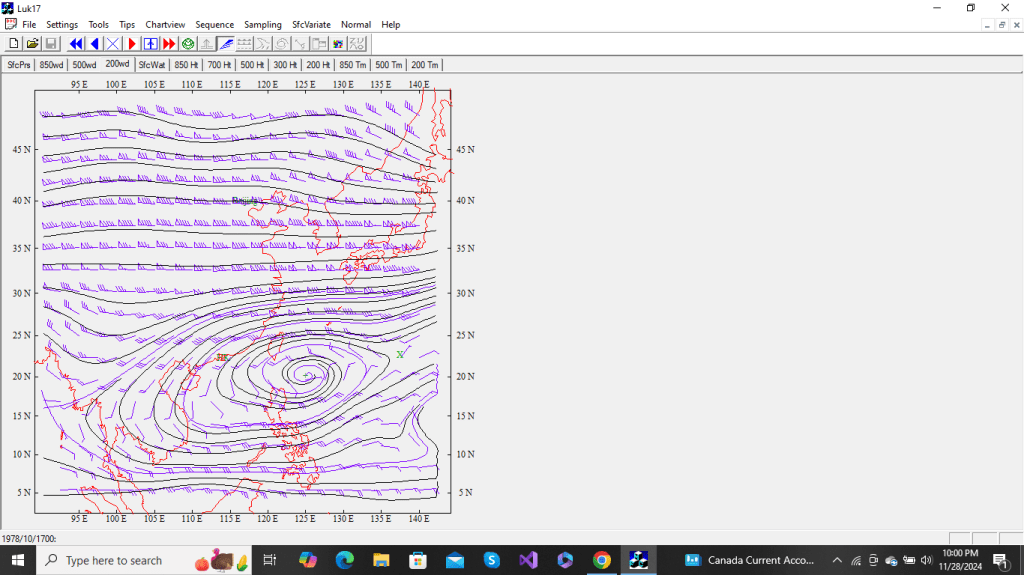

End of spell
Additional example for Cat2 Case 1 but this time, axis curvature on an anticyclone west of HK is enhanced instead.
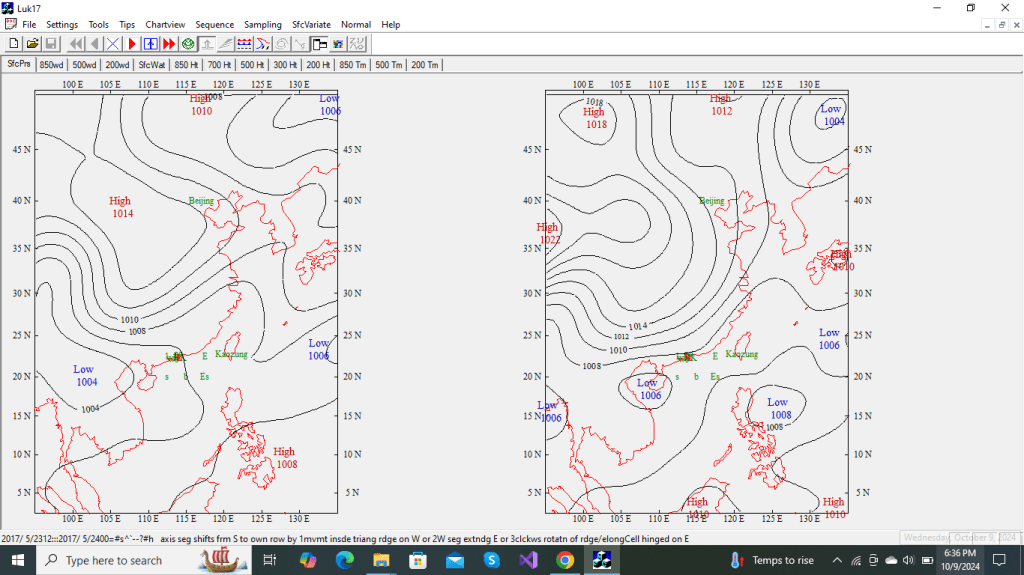
———————————————————(204.7mm) 17052400
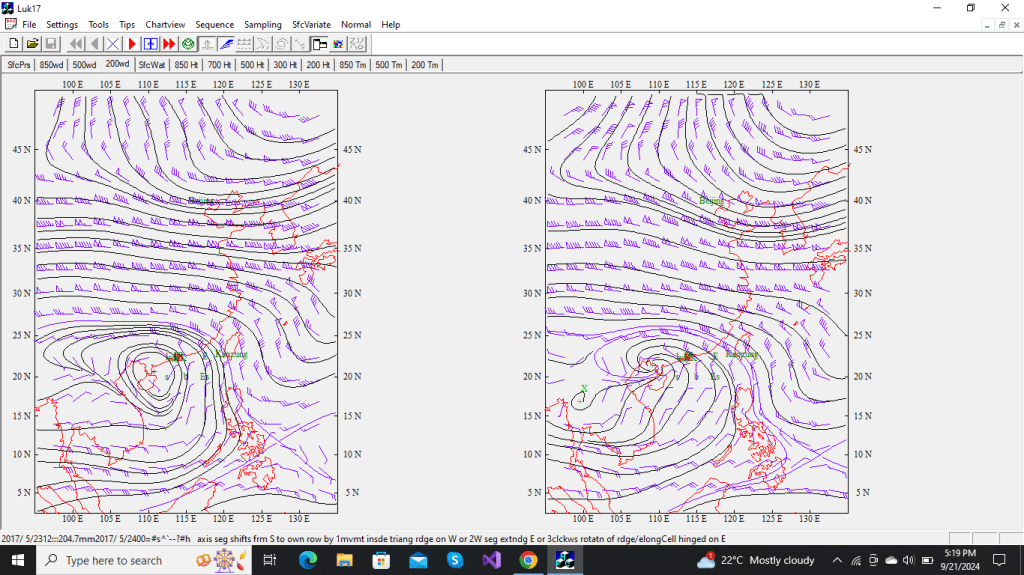
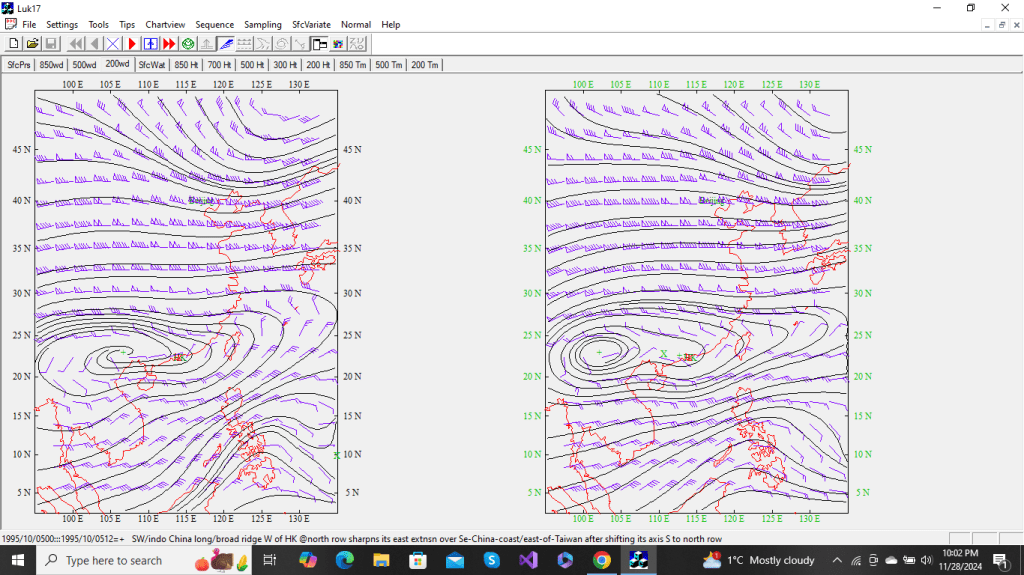
Cat 2 Case 2: 249.5mm – 95100512
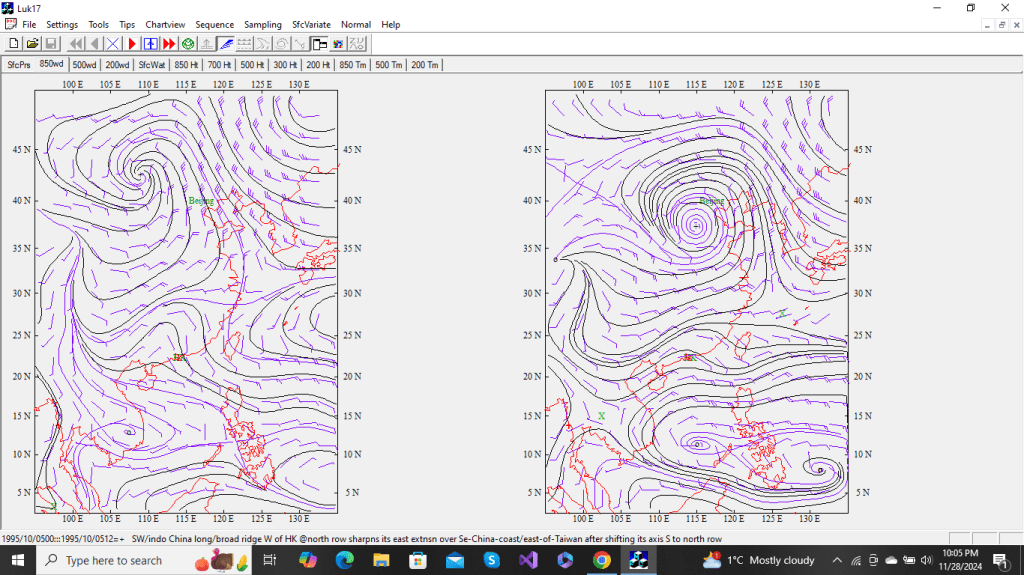
Synoptic scenario : On the east extension of a broad horizontal West China ridge, the west-of-HK axis on own row at H-12 moved north to align at H+0 with the east-of-HK axis on north row.
The next 4 behavior types occur at seasonal transition months between late spring and early summer.
Cat 2 Case 3(spell)Target H+0
Synoptic scenario – On the east extension of a broad horizontal West China ridge, ridge shows counter-clockwise axis tilting (between H-12 & H+0) towards own row followed by its west-of-HK axis sharpening at H+12 on own row:
——————————————————–(208.4mm) 83061612TargetH+0
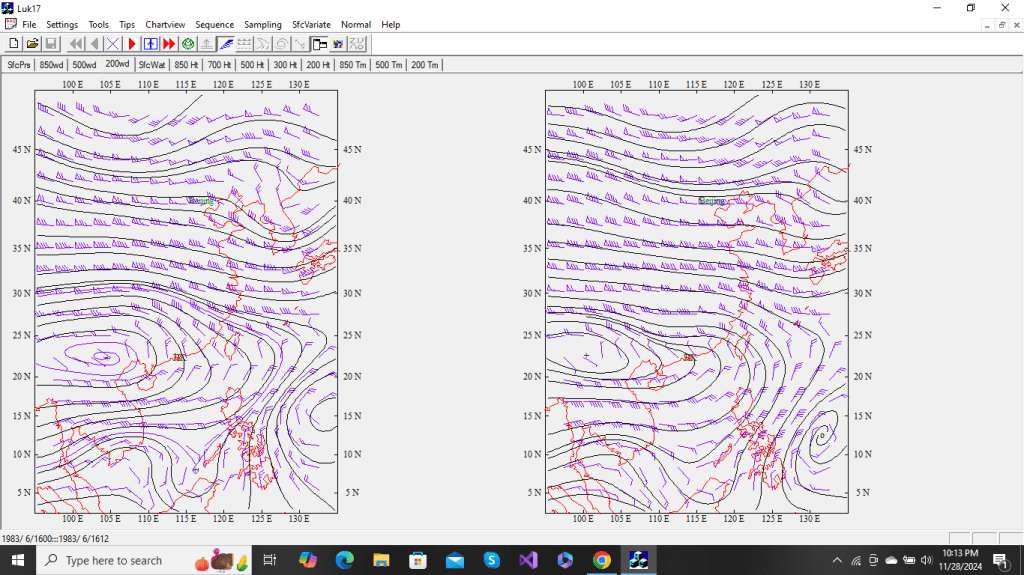
(135.5mm)
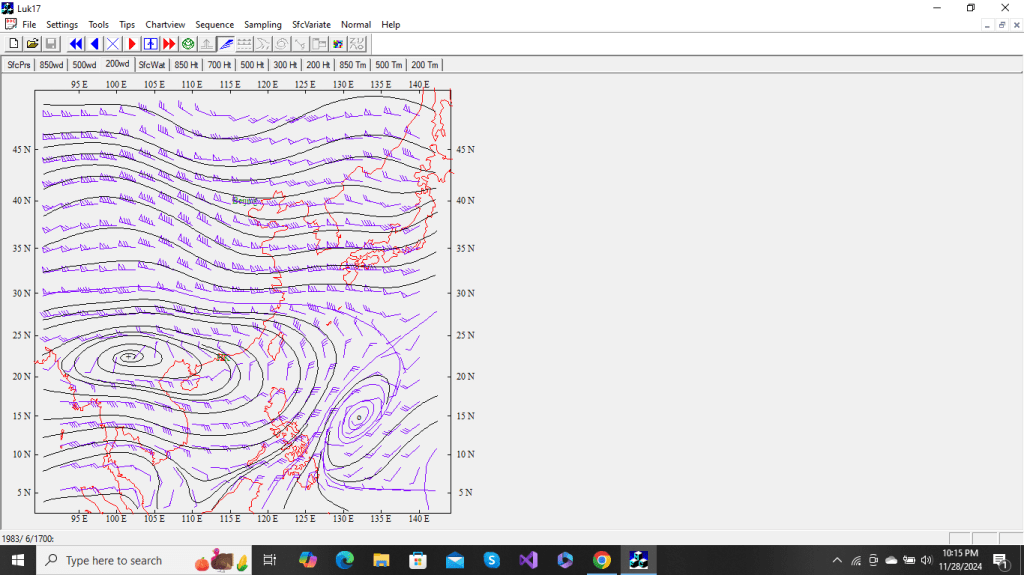
End of spell
Cat 2 Case 4: 202.3mm – 72061800
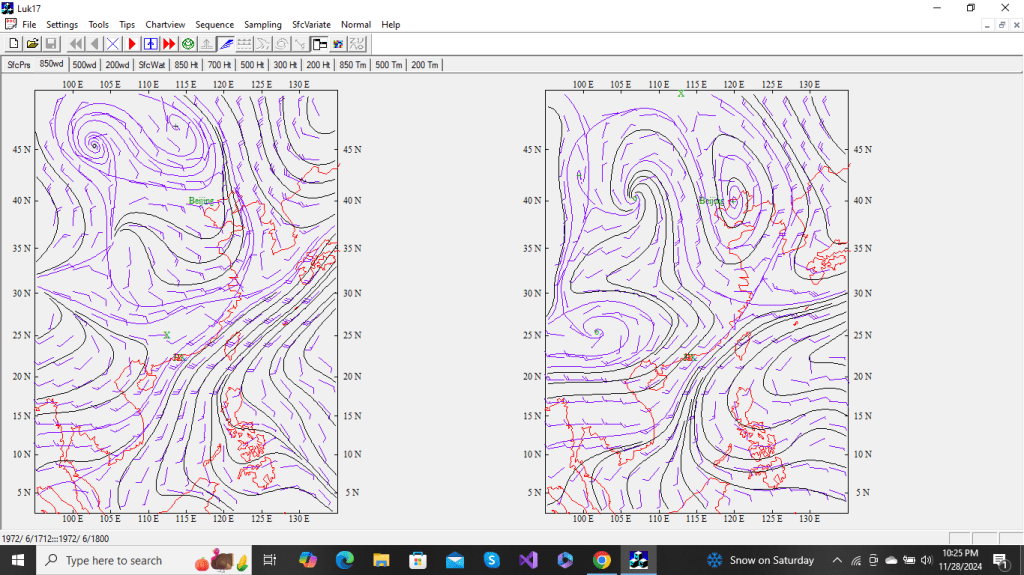
Synoptic scenario: HK lies in a ‘null wind’ area between horizontal westerlies to north and horizontal easterlies to south under the influence of the semi-rhombus ridge on the west side of the zone.
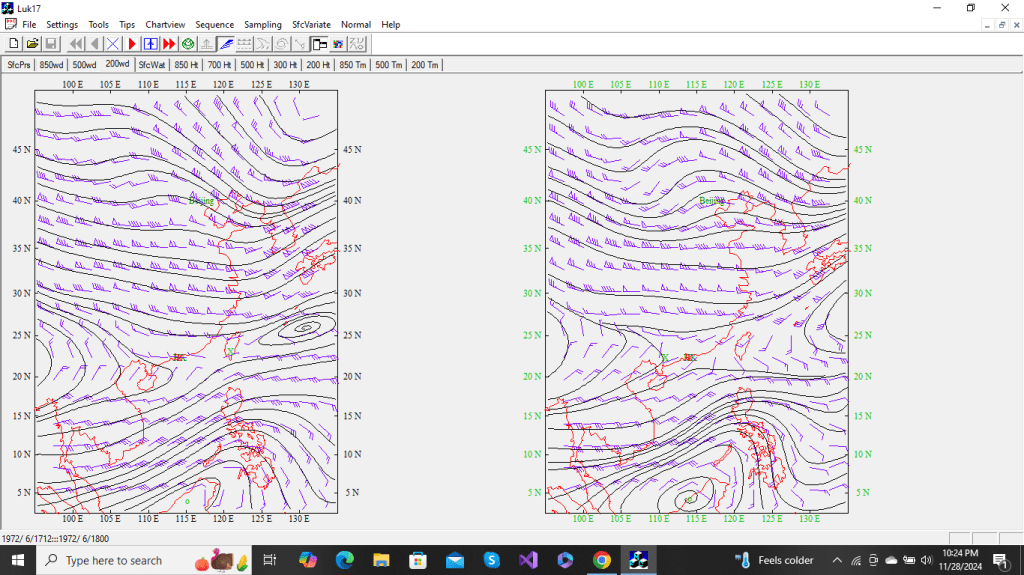
Cat 2 Case 4a (spell)Target H+0
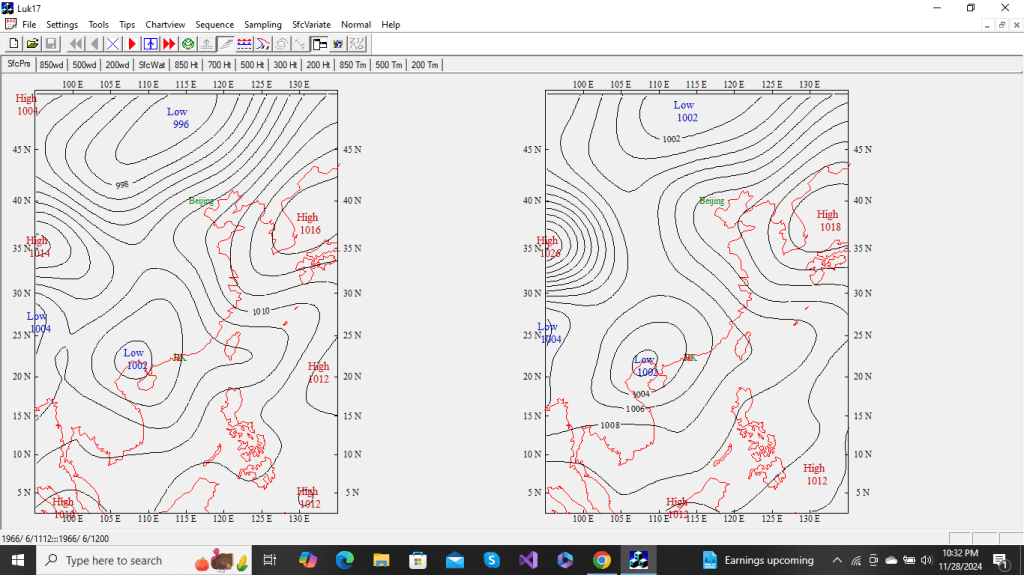
Synoptic scenario – HK is on the north-eastern edge of a triangular ridge with its axis dipping from southwest China to the Luzon Strait.
——————————————————–(245.3mm) 66061112TargetH+0
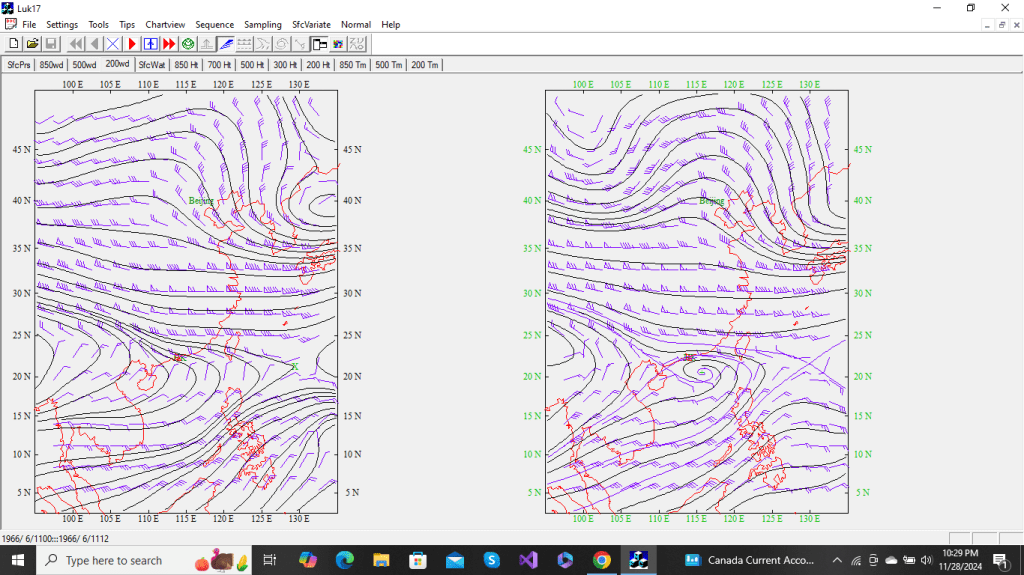
(142.2mm)
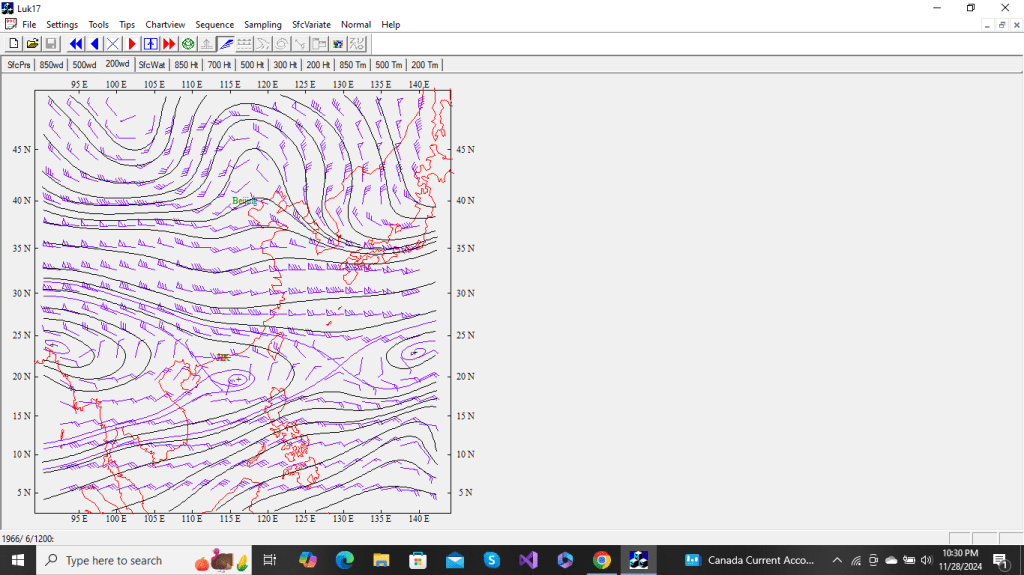
End of spell
Cat 2 Case 5(spell):Target H+12
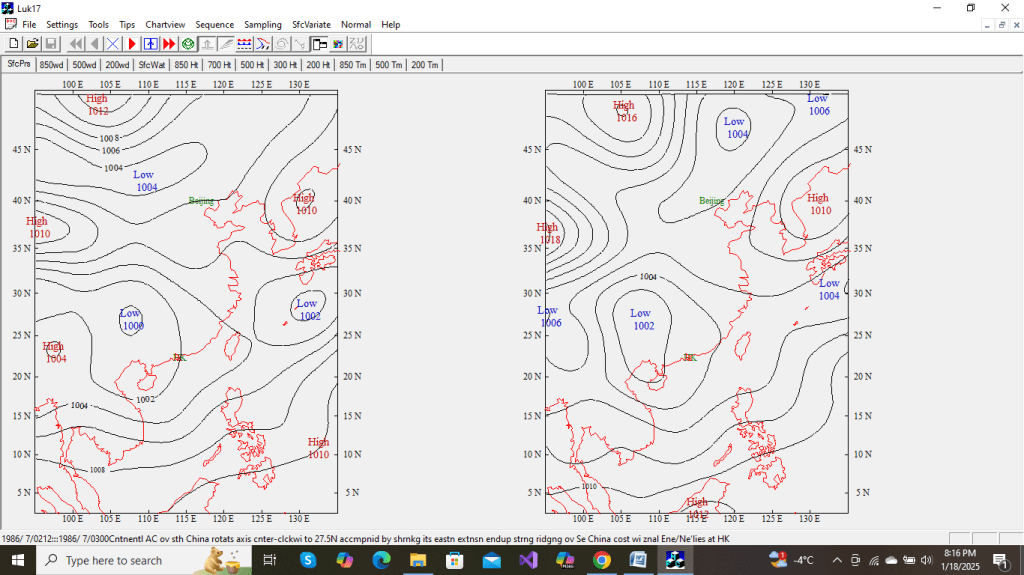
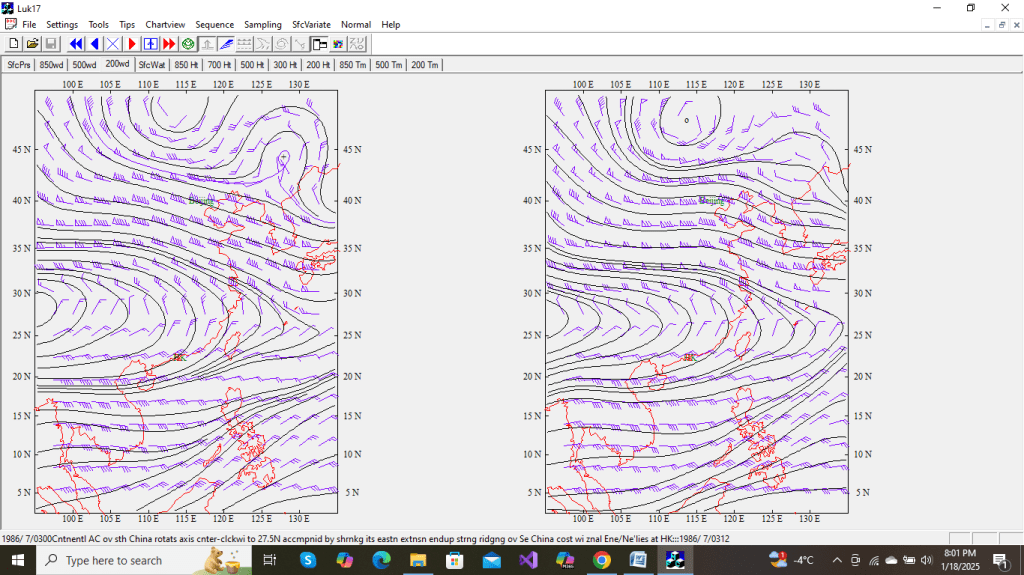
Synoptic Scenario: The following case represents a ridge type- the continental ridge which is mid-sized between the broad/semi-rhombus ridge discussed above and the continental anticyclone which centers at 25-27N over west China discussed in the CLOSE section. The horizontal ridge which centers at 27.5N impacts Hong Kong’s weather by intensification (which may be accompanied by an initial counter-clockwise axis rotation) through contraction, elongation and ridge curvature buildup over the Southeast China area.
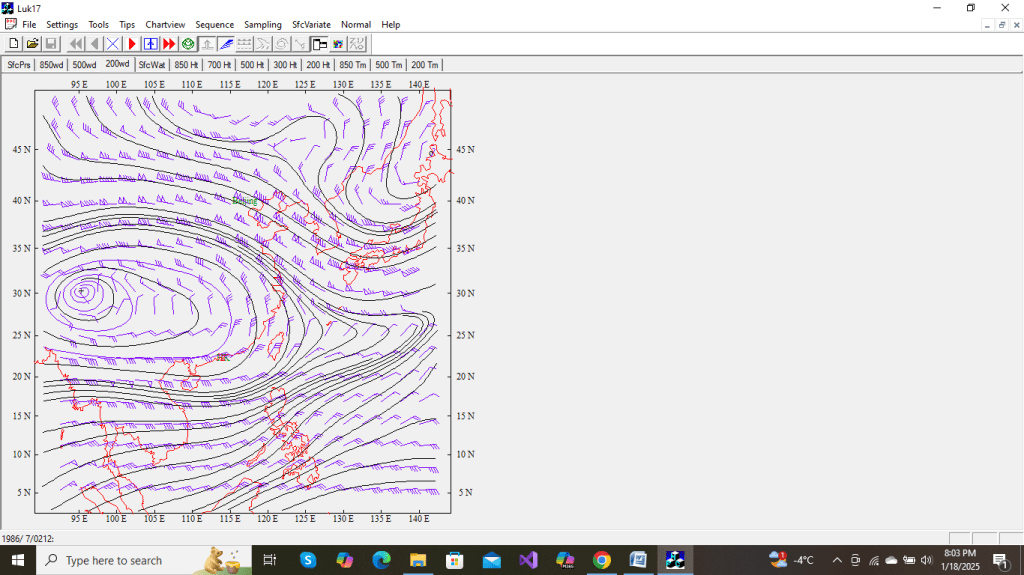
(87.3 mm)———————————————-86070300 (84.6 mm)TargetH+12
The third category
(roughly 35%) can be called the ‘synoptic approach’ category which focuses on synoptic development by specific features (anticyclones, westerly troughs, cyclones, and easterly waves) at specific geographical locations for the study.
There is a broad seasonal spread for behavior types in this category, with 23 cases occurring in summer and 46 cases (63%) occurring between December and early June in the cool season months.
Category 3 is presented by grouping Synoptic Feature types under Class
Class: Trough type
Trough type 1 295.7mm – 71081612H+0 :
Synoptic scenario type 1- To the north of a horizontal ridge over the South China Sea(H-12), a horizontal trough across South China intensified(H+0) with HK at the inflection point in between.
Trough type 2: 83.0mm – 02092112H+0:
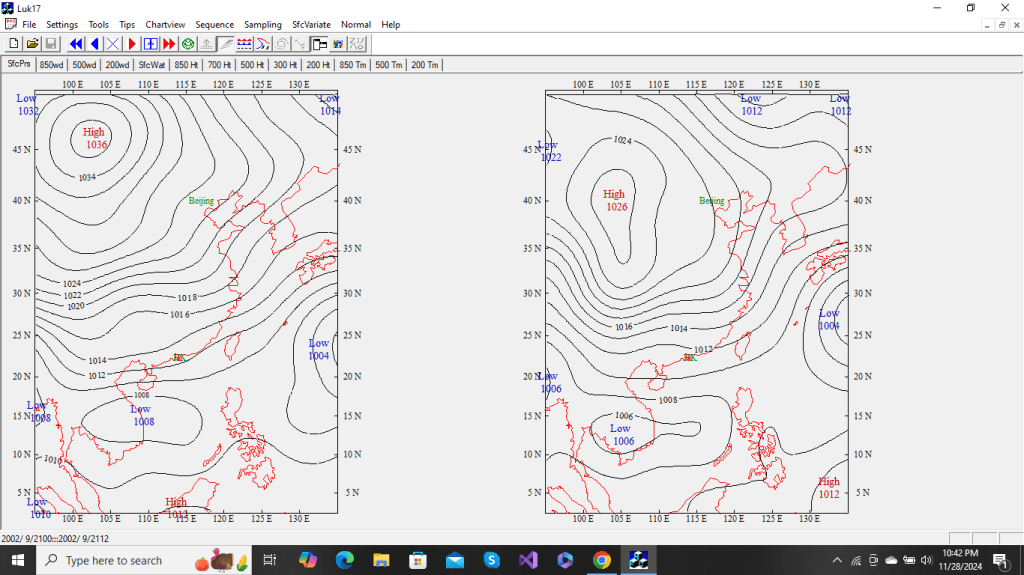
Synoptic scenario type 2- A large amplitude westerly trough with axis past East Taiwan(H-12) shifted westward(H+0) to cover the northeastern part of the SCS.
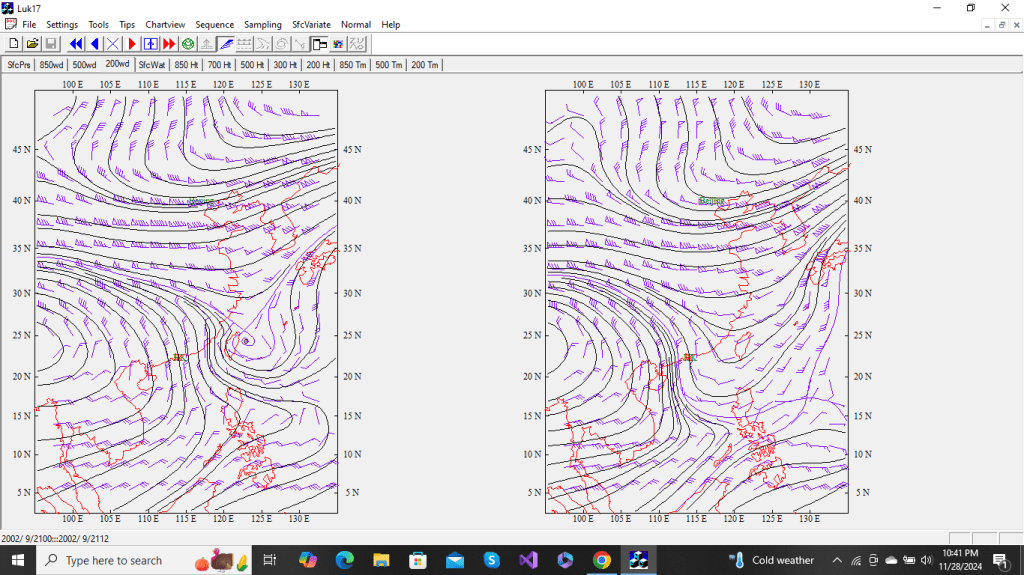
Following behavior prevails in the cool seasons.
Trough type 3: 204.3mm – 89050200H+0
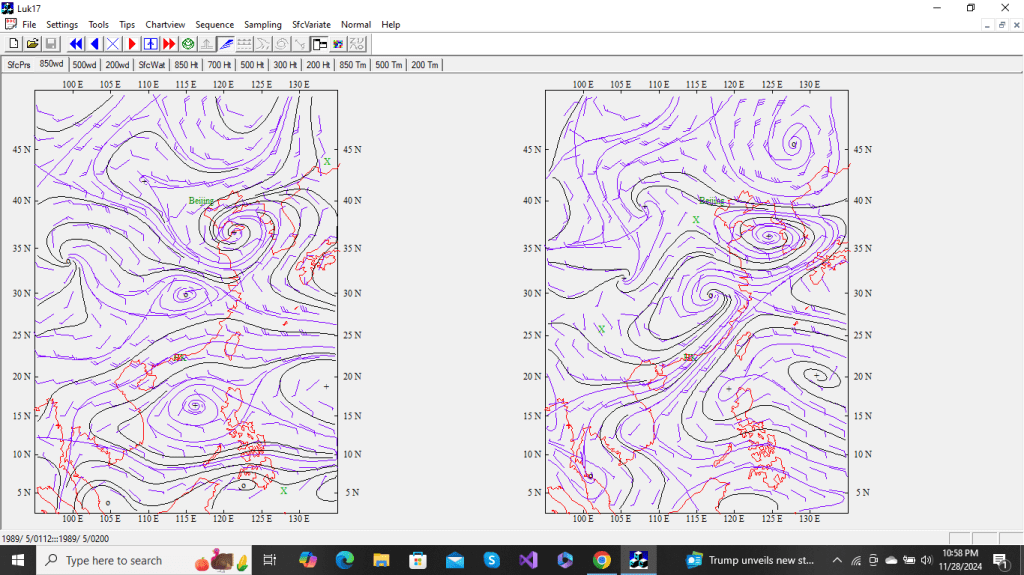
Synoptic scenario type 3- A fast-moving westerly wave (H-12) approached Hong Kong(H+0) after significantly shrank its amplitude.
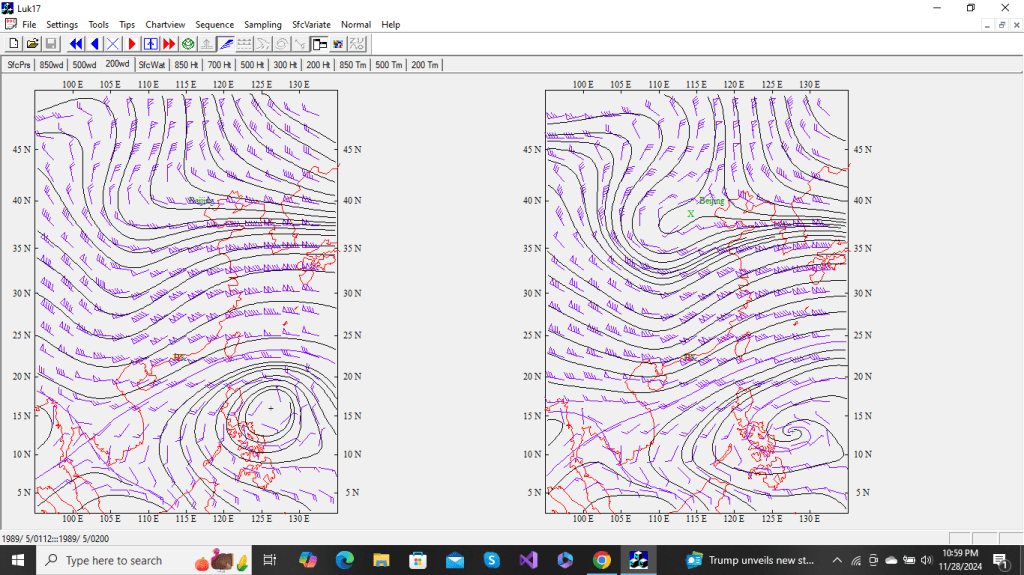
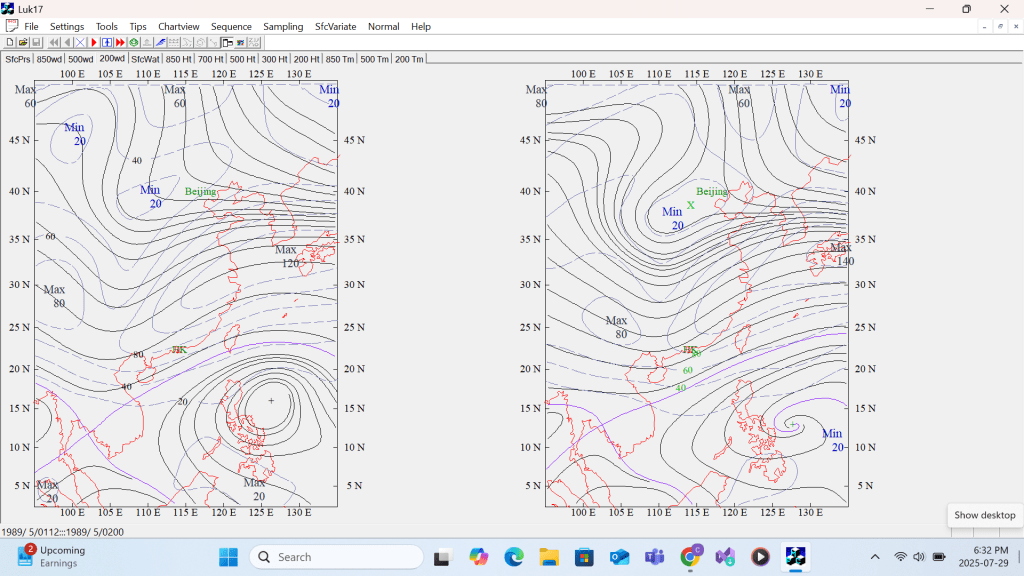
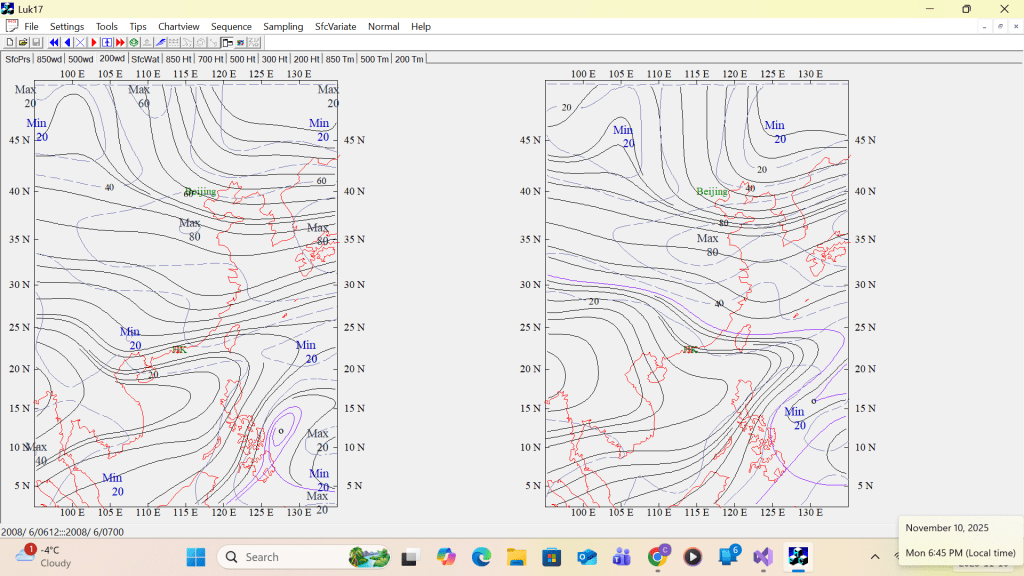
The right isopleth chart shows speed divergence
The scenario of the following 2 developments focuses on activities on trough over central China ahead of the west China ridge centred at 25N.
Trough type 4: 218.7mm – 68061212H+0
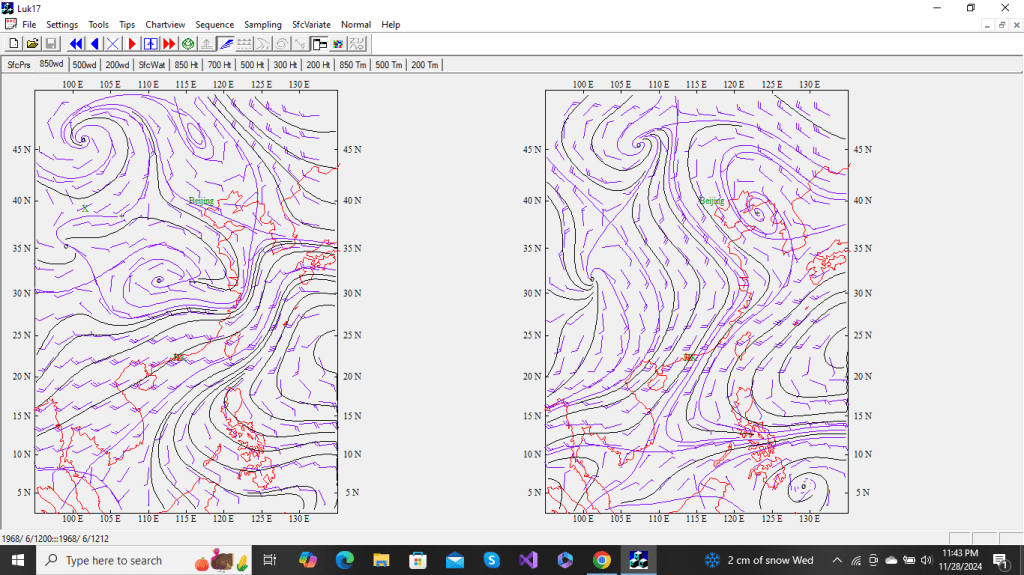
Synoptic scenario type 4- After its passage through HK(at H-12), the amplitude of a westerly trough flattened(at H+0) over the East China coast followed closely by a drastically expanding ridge over Southwest China.
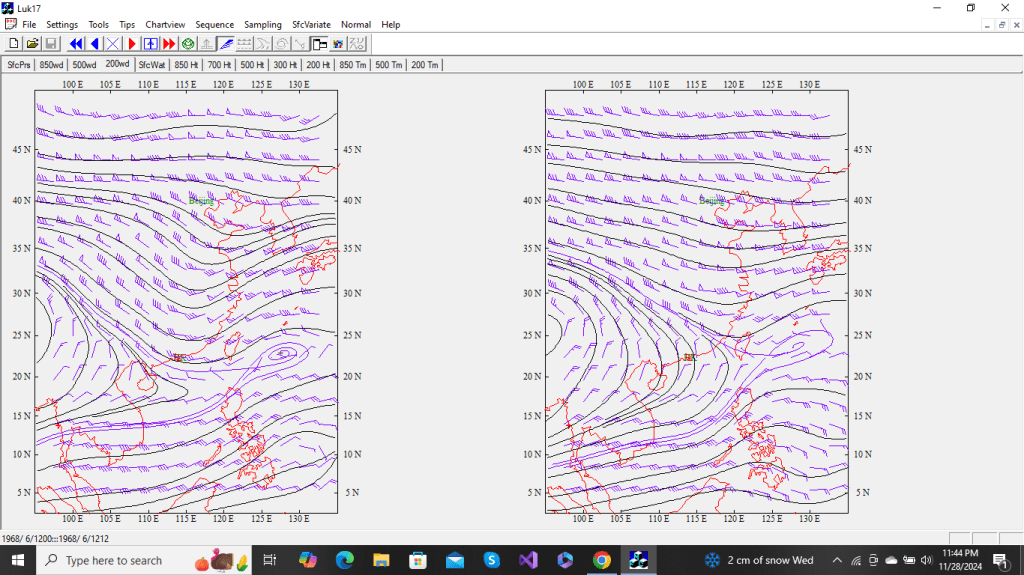
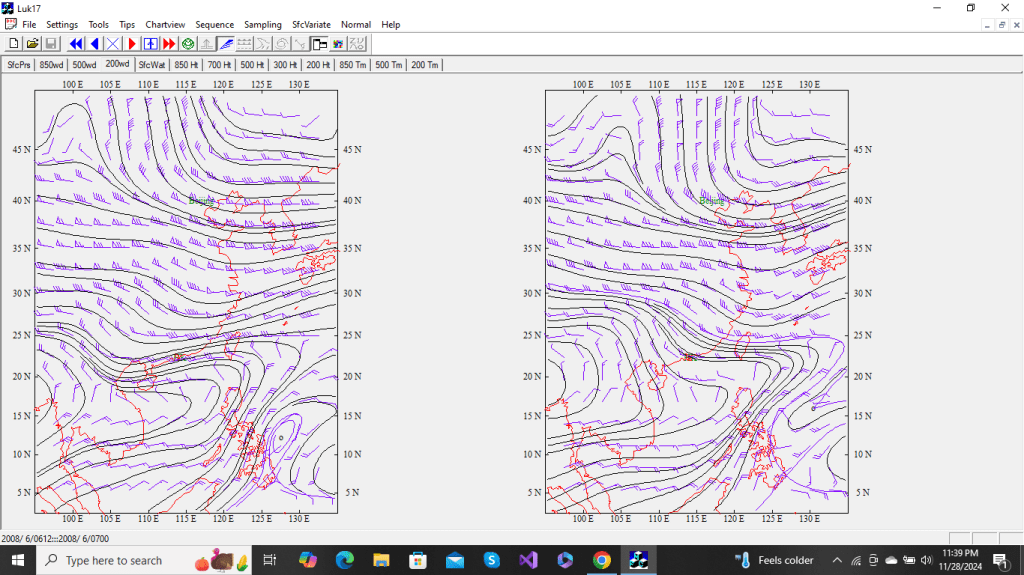
Trough type 5(spell) : Target H+24
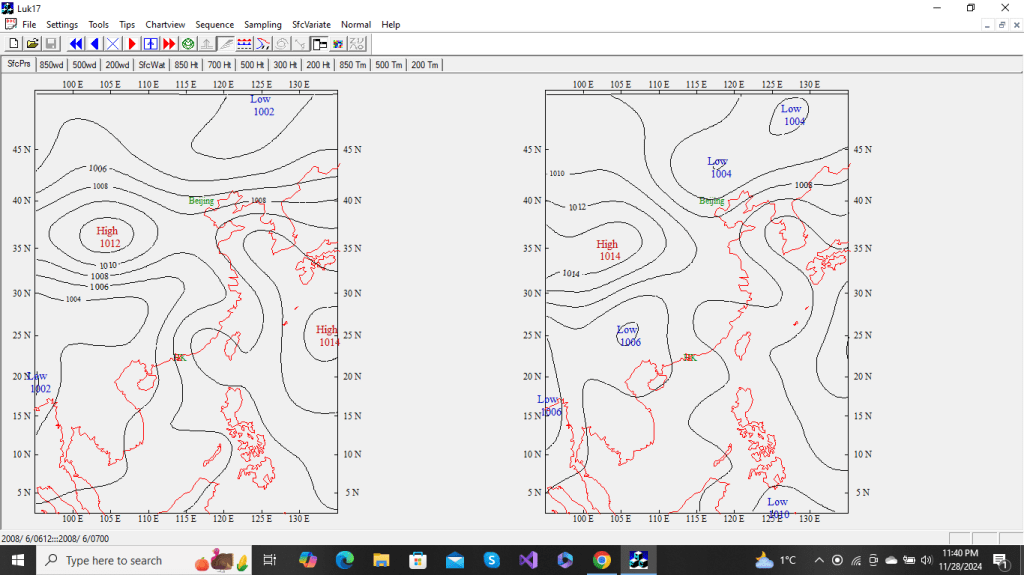
Synoptic scenario type 5- Sitting on top of a large horizontal anticyclone across northern Indo-China and the South China Sea, a shallow, skewed, forward-tilting westerly tough far west of HK(H-12) deepened(H+0), moved eastward(H+12) and reached Hong Kong(H+24).
———————————————————(116.7mm)H+0
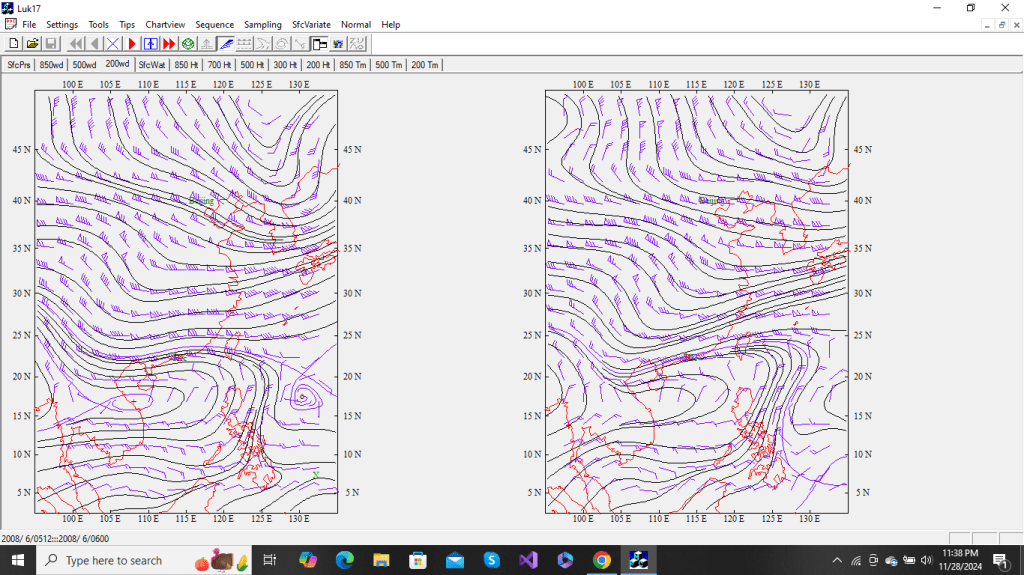
(119mm)H+12——————————————(199.6mm) 08060700TargetH+24
Class type B Anticyclone
1 Type 1: SW China Continental Anticyclone – 91101500
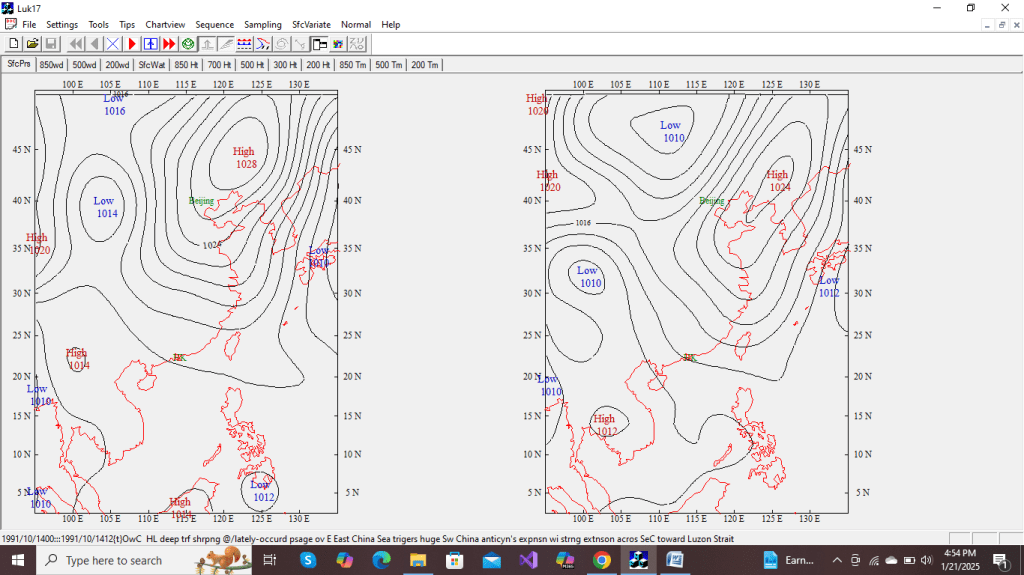
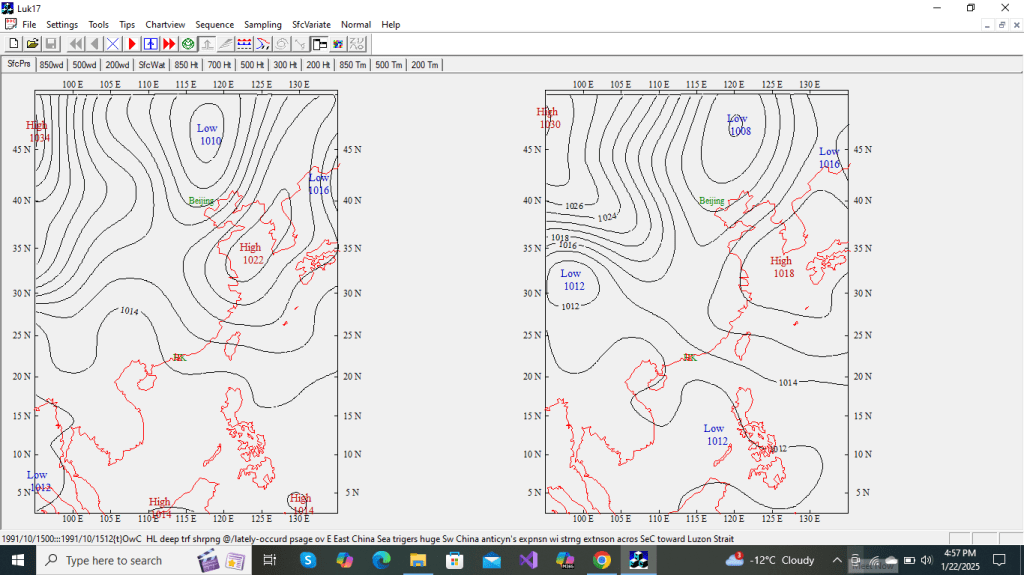
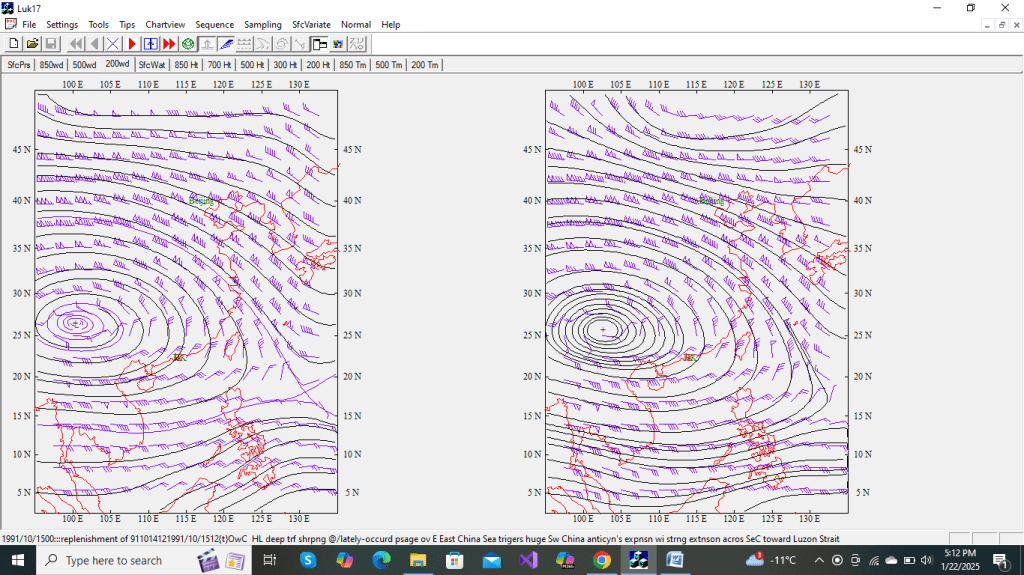
Synoptic scenario type 1- The southeast ridge of a huge SW China anticyclone was twice (at H+0 and H+24) sharpened over SE China coast, northeast SCS and Luzon Strait by deep high-latitude westerly trough’s passage over Korea at H-12.
———————————————————(122.9mm) 91101412H+0(first occurred period)
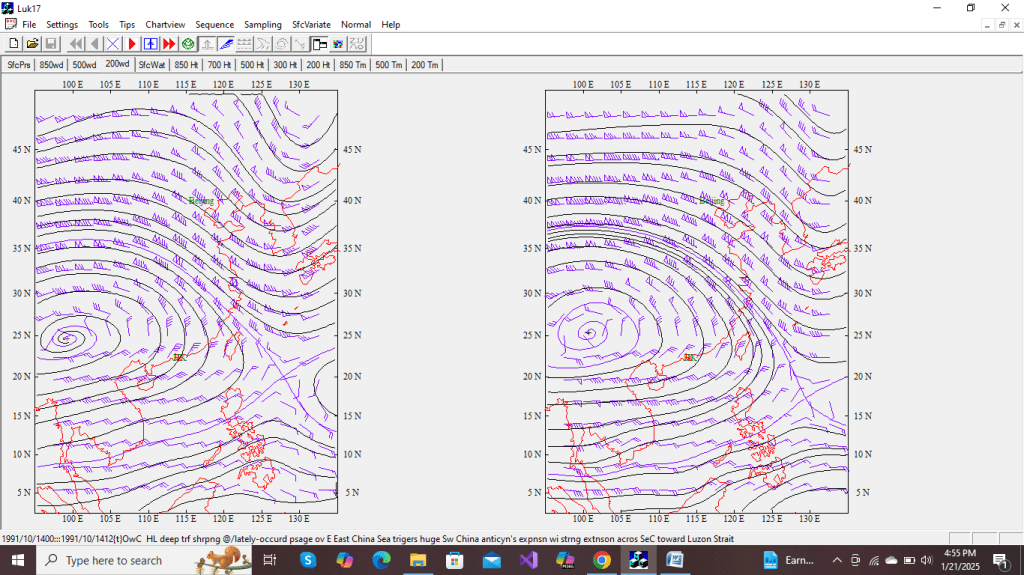
36.4mm(temporary relief)————————–(87.7mm) – 91101512H+24(second period)
Type 1a SW China gigantic Anticyclone: (spell)Target H+0
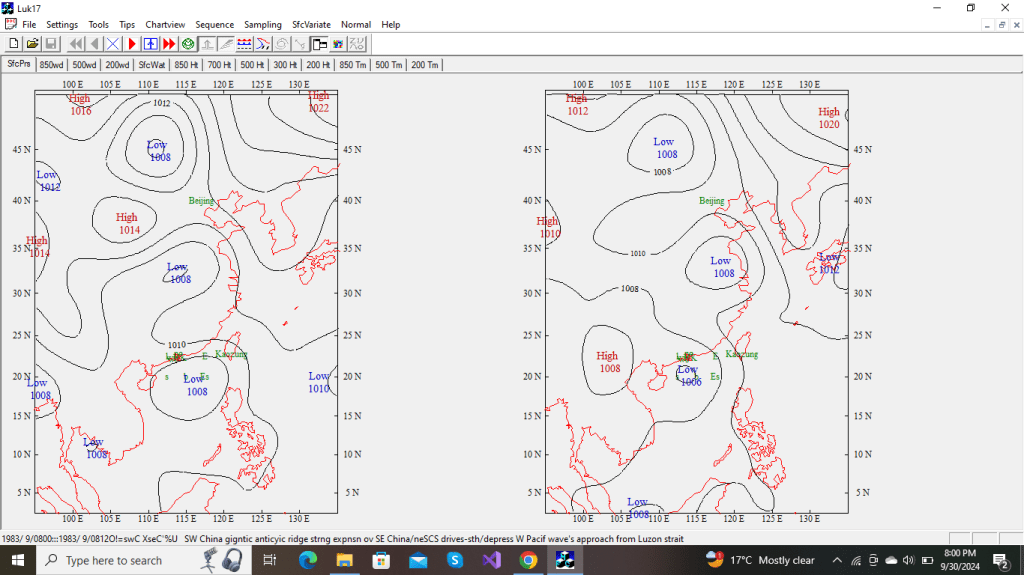
Synoptic scenario type 1a- The clockwise rotation of entire ridge axis from 32.5N(H-12) to 30N(H+0) caused a southern depression on the horizontal trough to its southeast. Further rotation from 30N to 27.5N with east-side expansion caused an easterly wave-like perturbation formation at HK(H+12) :
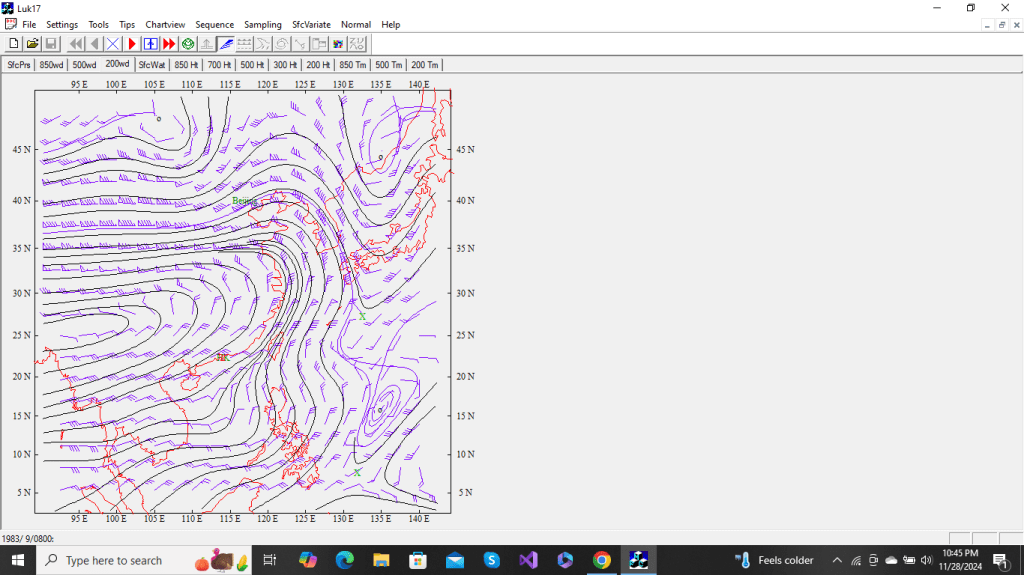
(101.7mm)83090812TargetH+0—————————-(98.0mm)H+12
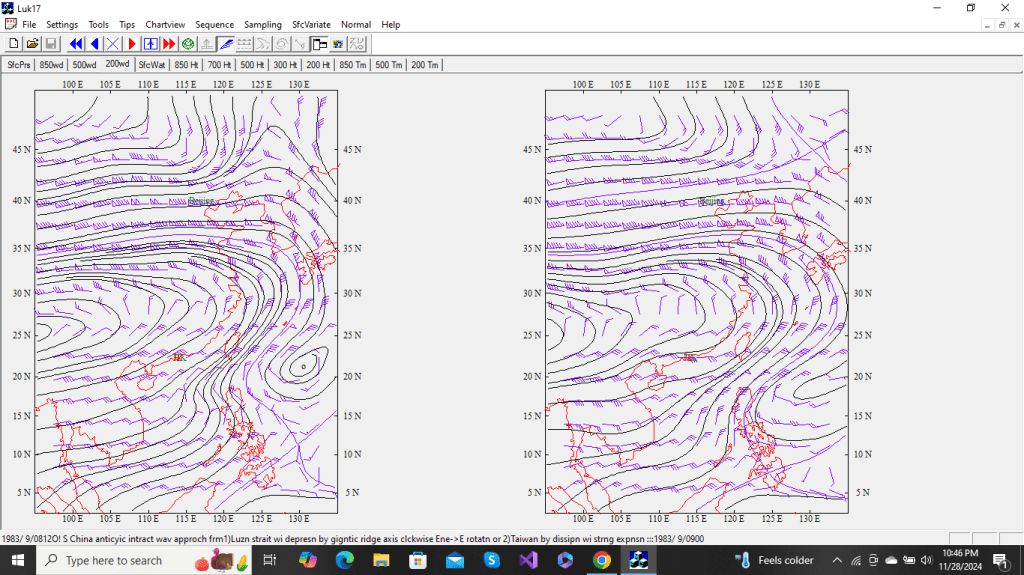
End of spell.
Type 2 Anticyclone over Northwest Pacific to the east of Taiwan
211.6mm – 16101900
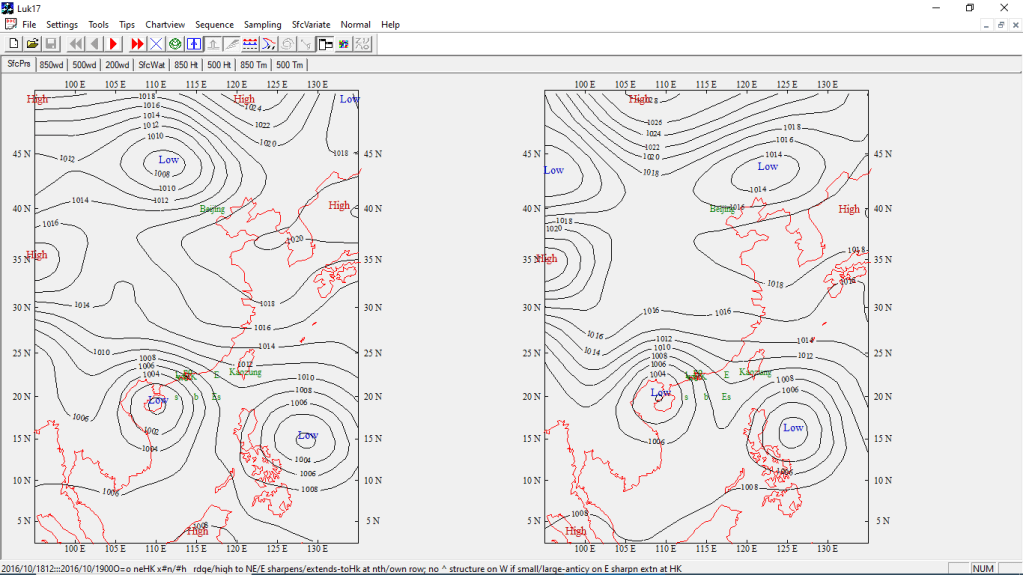
Synoptic scenario type 2- The anticyclone sharpened its horizontal westward extension ridge over the South China coast.
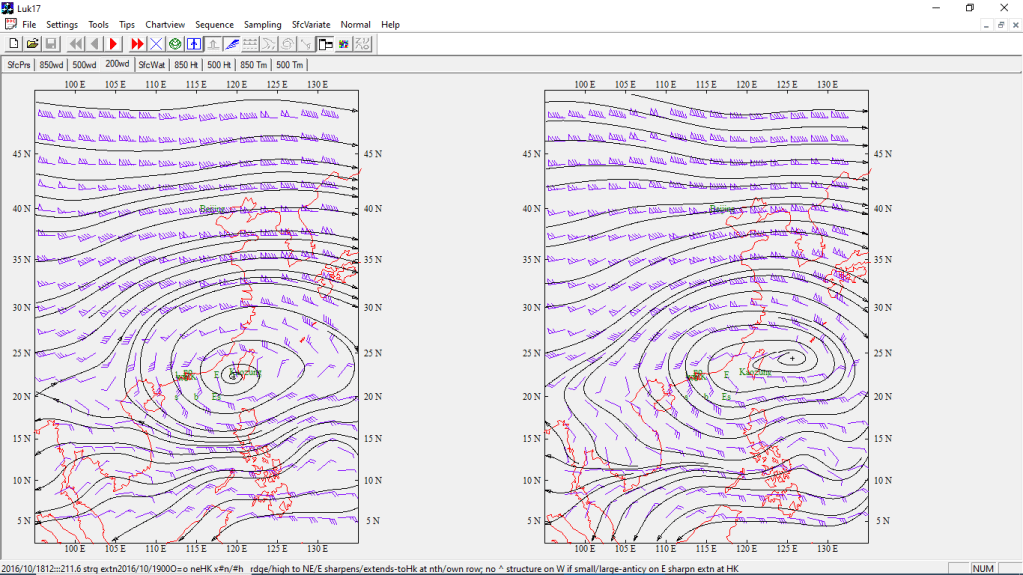
Second example
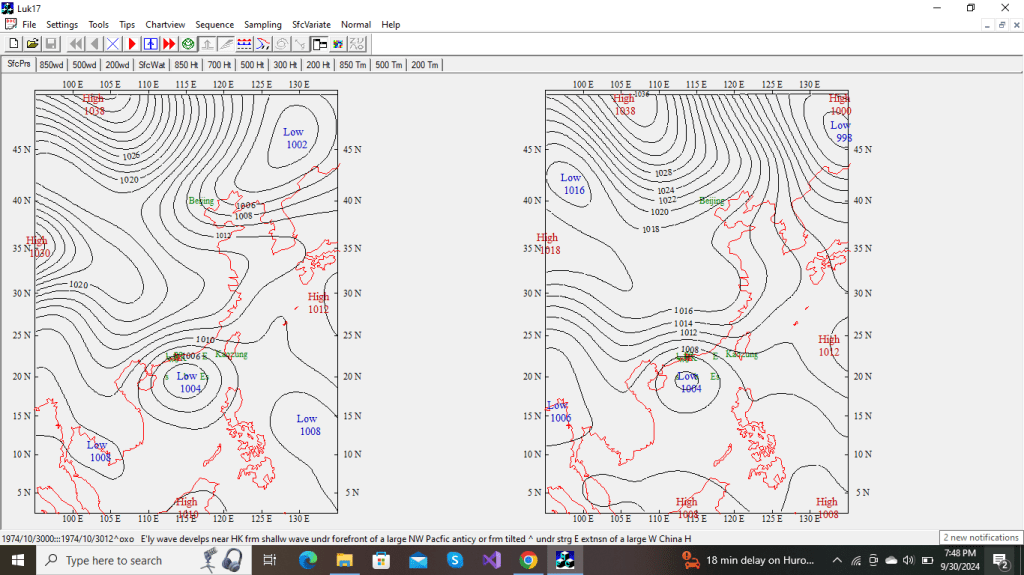
Synoptic scenario type 2a- The anticyclone degenerates to sharpen its axis along the ‘own row’.
65.5mm———————————————–(130.6mm) 74103012
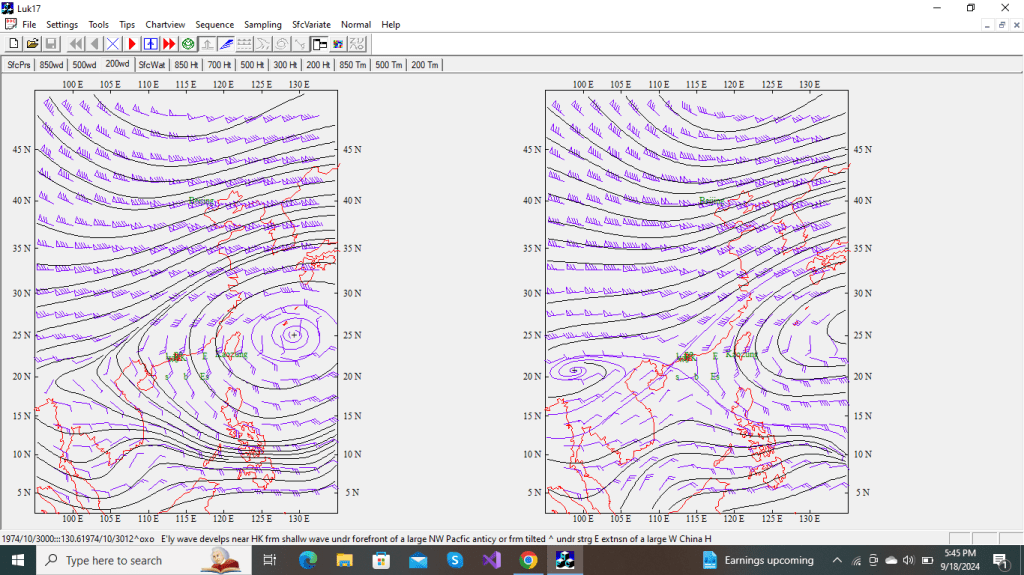
Following behavior prevails in the cool seasons.
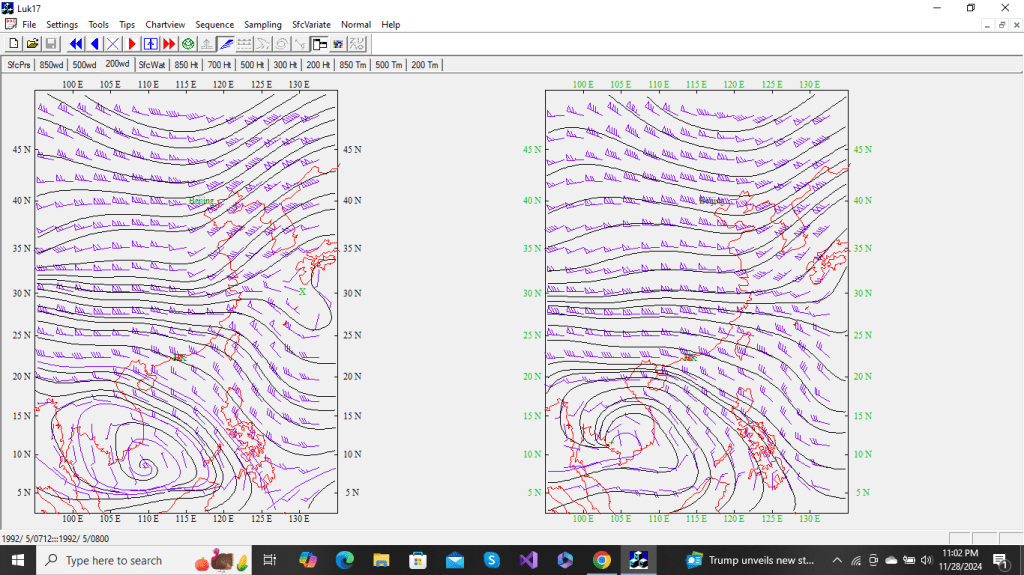
Type 3 Southern Vietnam coast Anticyclone (spell)Target H+0
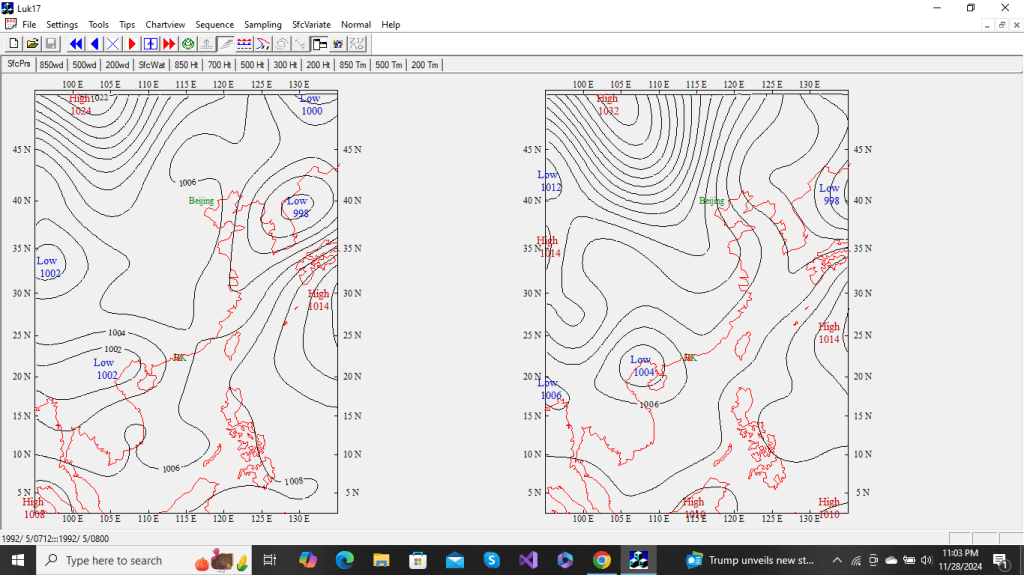
synoptic scenario 3 – the anticyclone first sharpens(H+0) its ridge at HK and then expands northeastward(H+12) across the SCS towards HK.
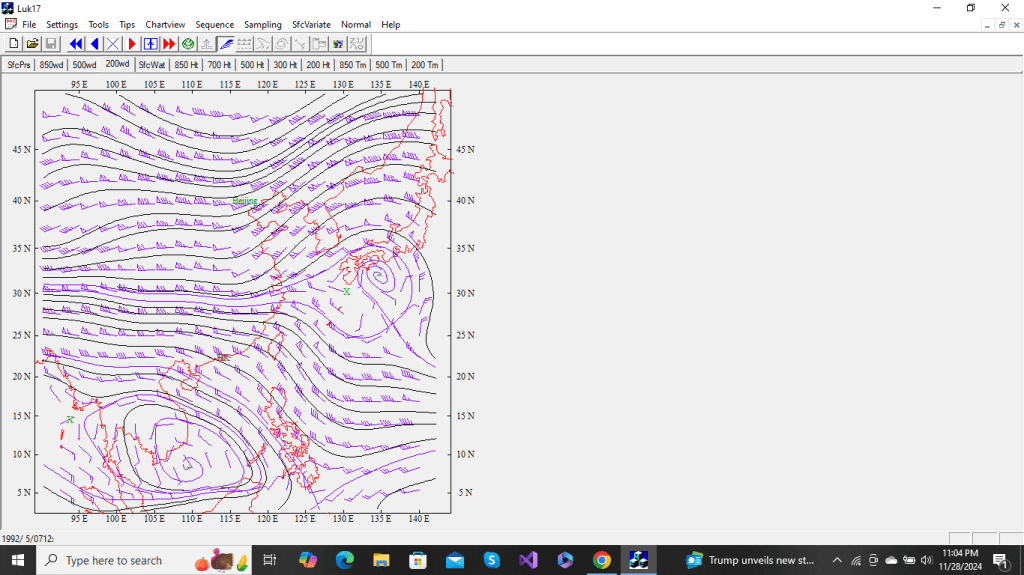
(170.4mm)TargetH+0—————————————(153.7mm) 92050800H+12
End of spell
Type 4 Anticyclone over the northern part of the SCS: 205.1mm – 70051300
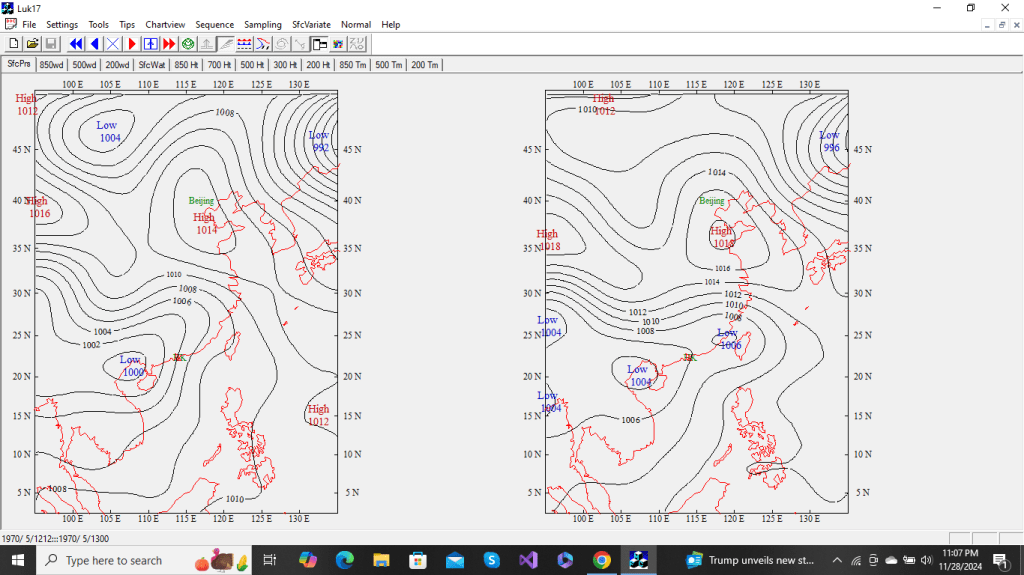
Synoptic scenario type 4- Small SCS circulation(H-12) intensified to a large strong anticyclone(H+0) on situs with sharp horizontal east axis built on ‘own row’ close to HK.
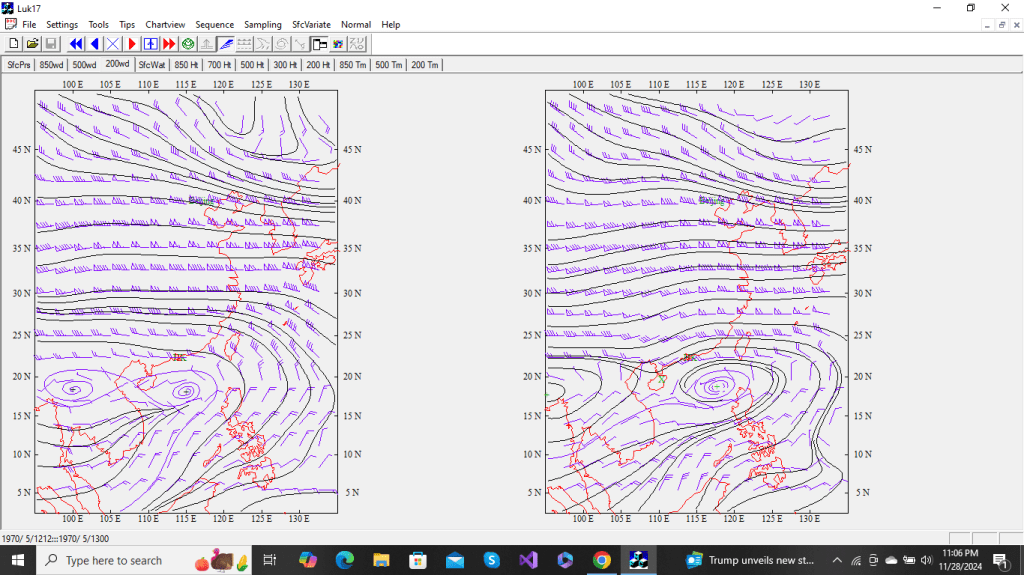
Second example (spell)Target H+12
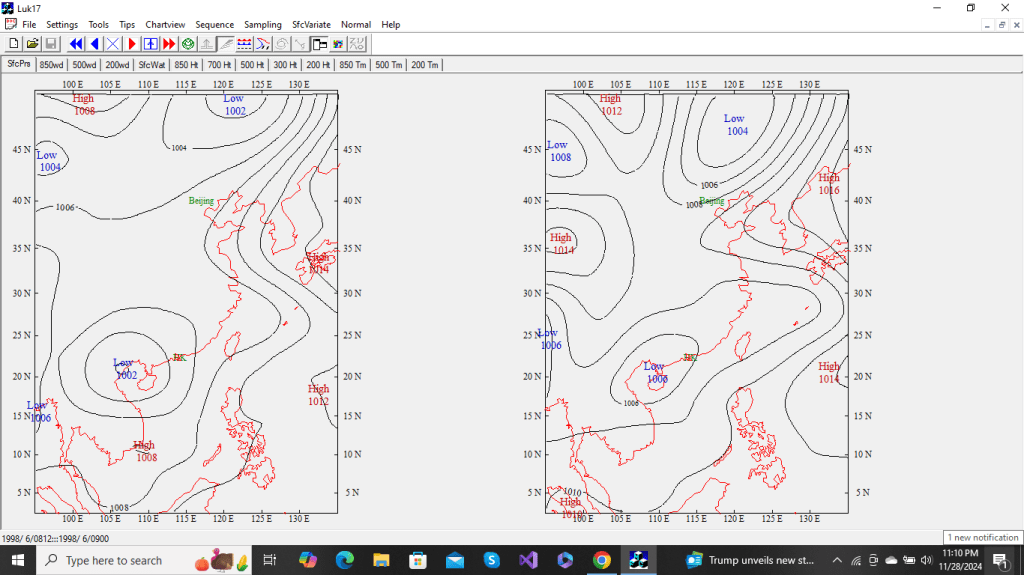
Synoptic scenario4a – the shallow westerly trough(H-12) to the west of HK intensified gradually(H+0) to a deep trough(H+12) by the tremendous ridge expansion over the South China Sea and the Western Pacific regions.
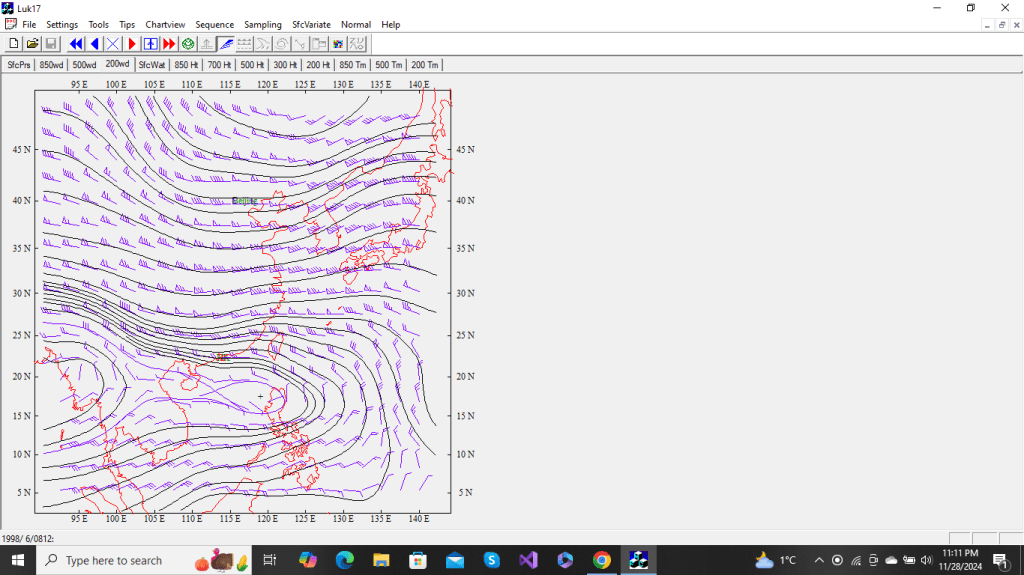
(167.1mm)H+0—————————————(260.1mm) 98060900TargetH+12
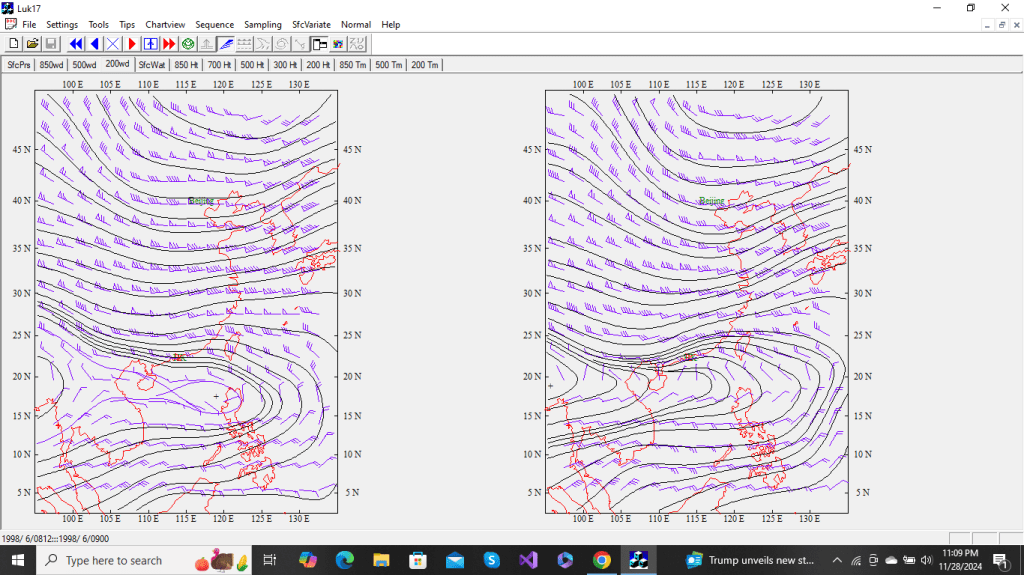
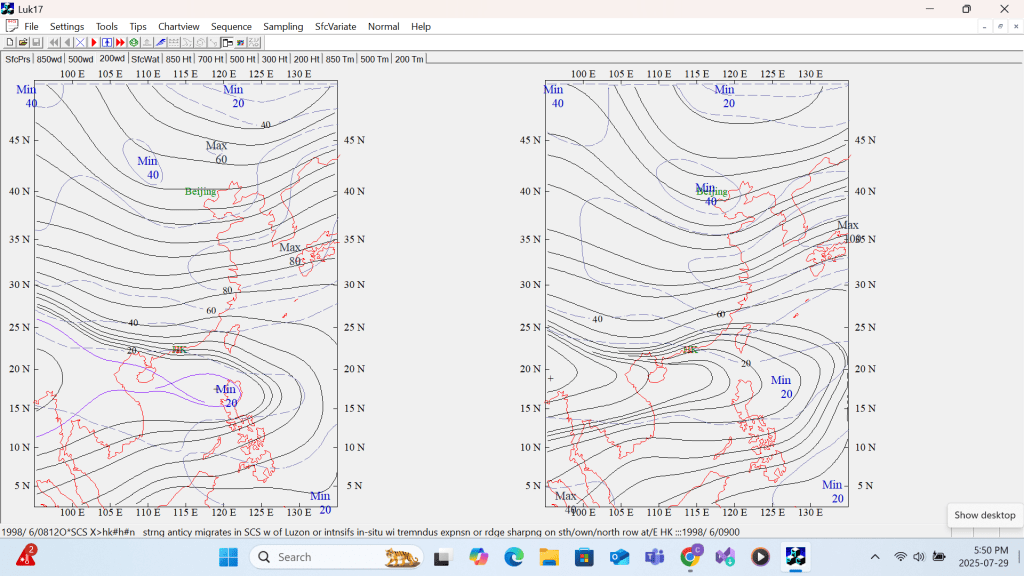
End of spell
Here comes the most dramatic, challenging and inspiring(leading to the discovery of a frequently occurred behavior type.
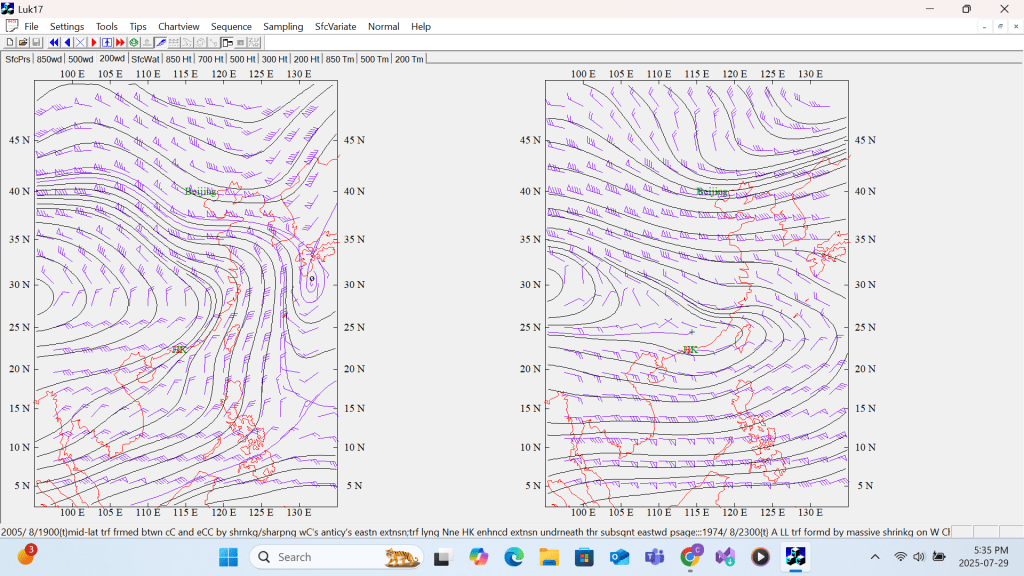
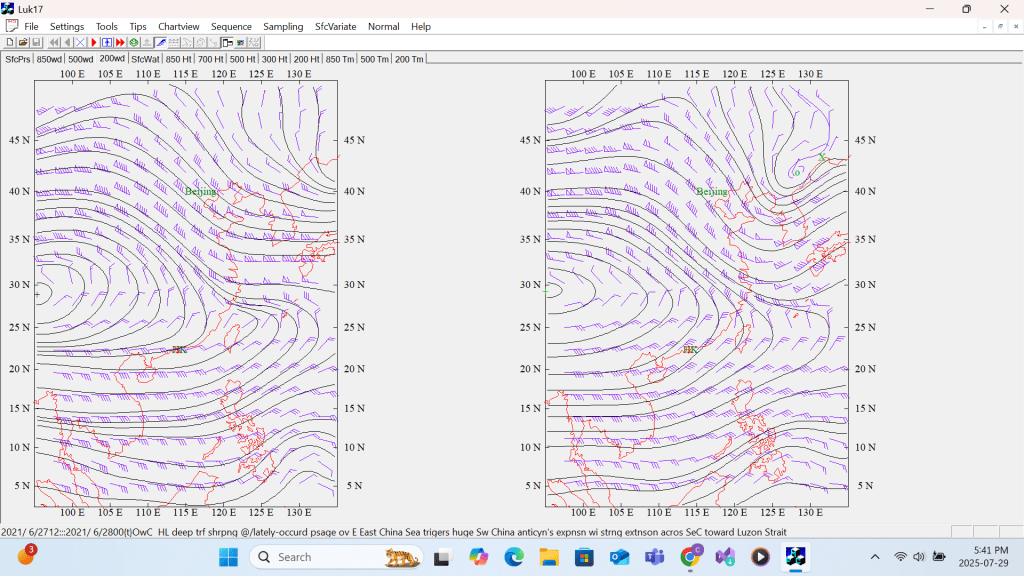
Type 5 Anticyclone on mainland China with an eastern ridge extension beyond the East China coast had its northeastern portion being shrunk or penetrated by vertical trough(spell) Target H+24
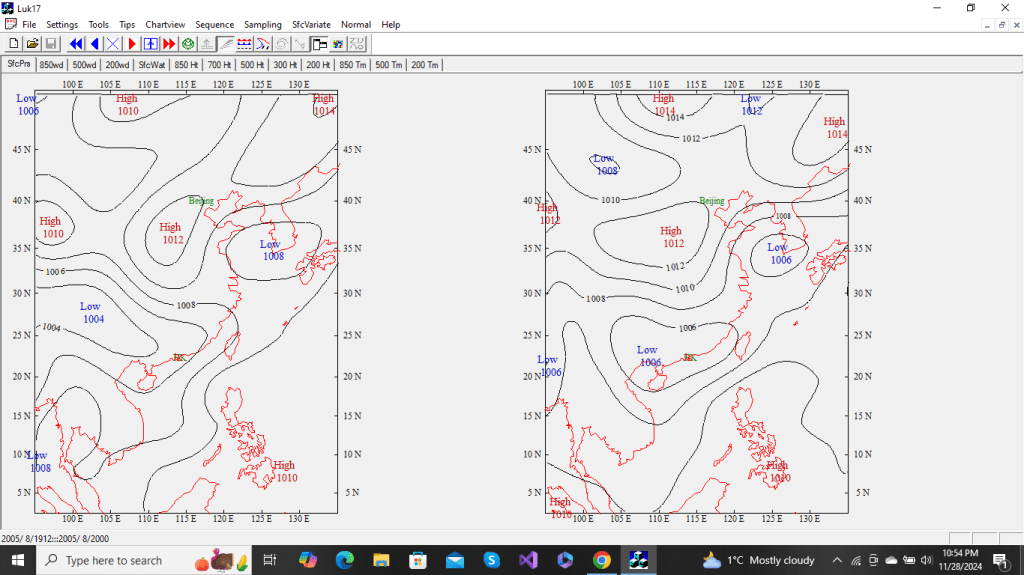
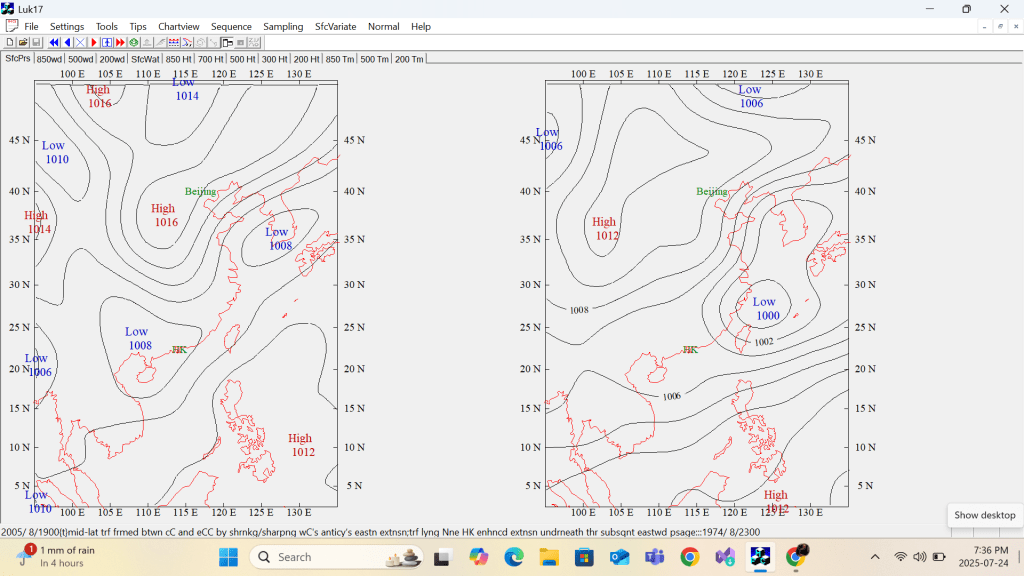
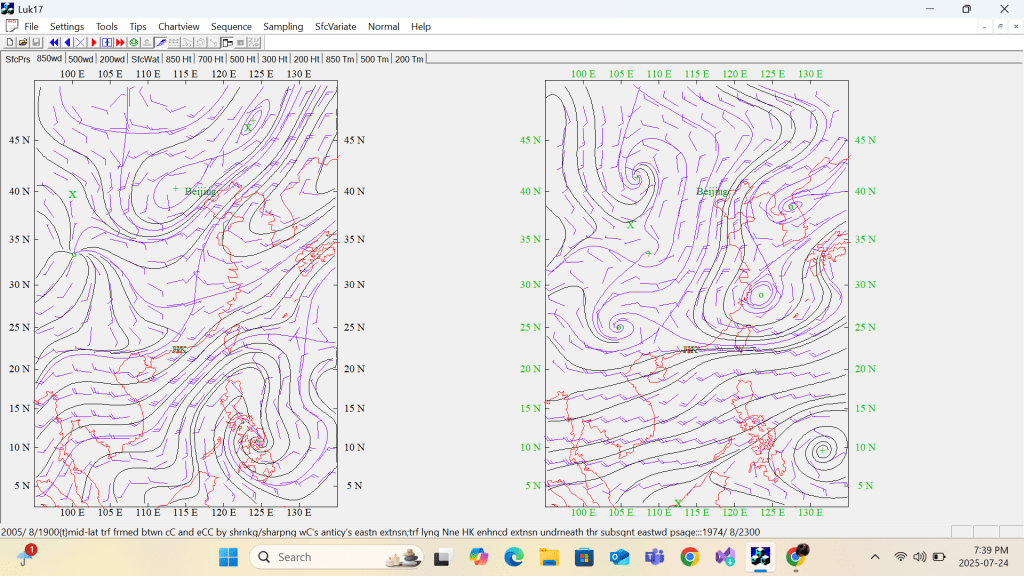
Synoptic scenario type 5: If a trough’ position (moving east from a previous-12hr position or newly formed) between Central China and the East China Coast to the North-northeast of Hong Kong) produced deep ridge-shrinking or ridge-penetrating effect on the northeastern side of a West China anticyclone, the situation would trigger tremendous ridge expansion over southeast China and the northern part of the South China Sea.
———————————————————(106.8mm)H+0 trough newly formed
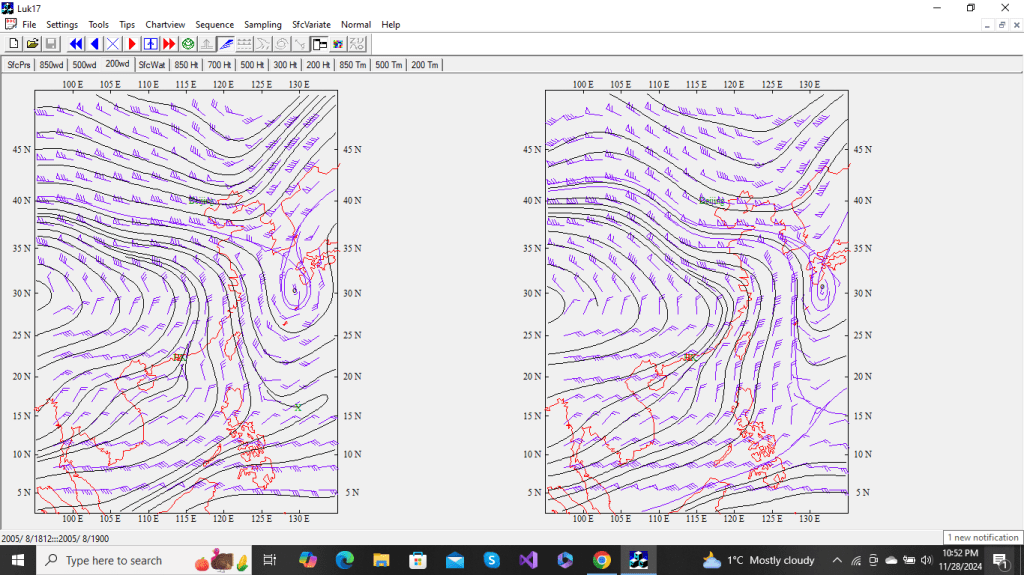
(179.8mm)——————————————–(208.8mm) 05082000TargetH+24
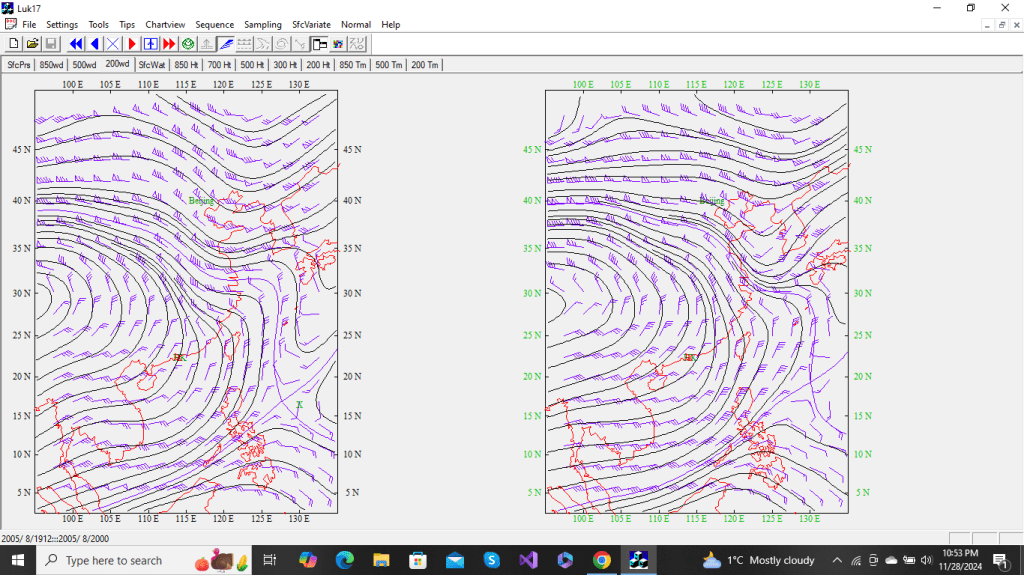
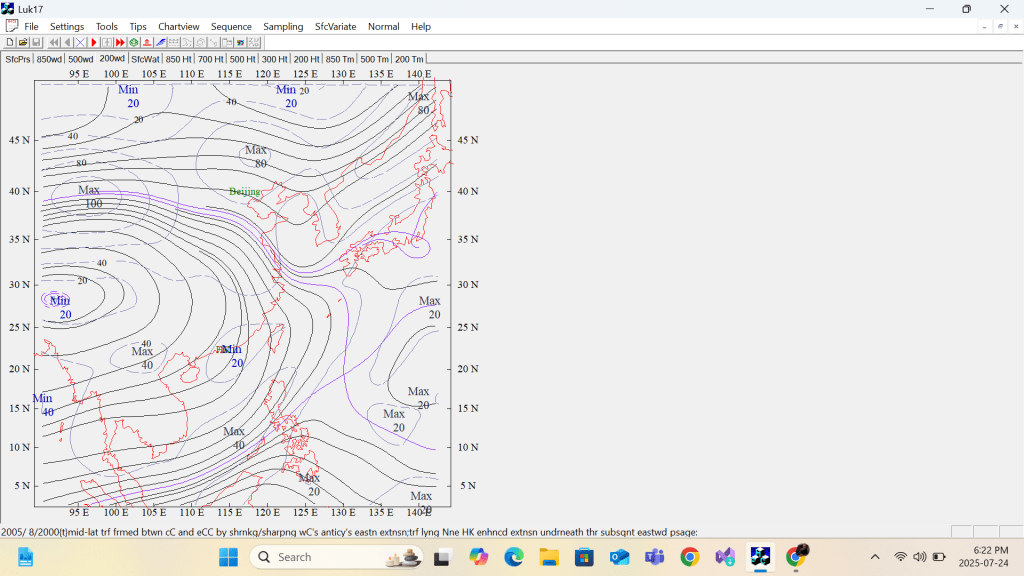
End of spell
First example case for comparison with case above at H+0
H-12————————————————–(126.7 mm)H+074082300
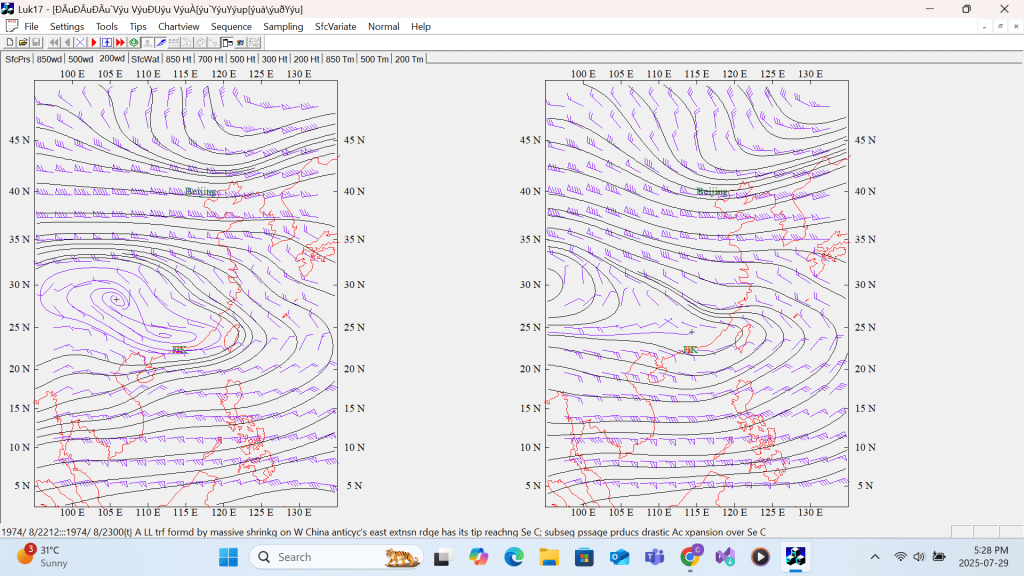
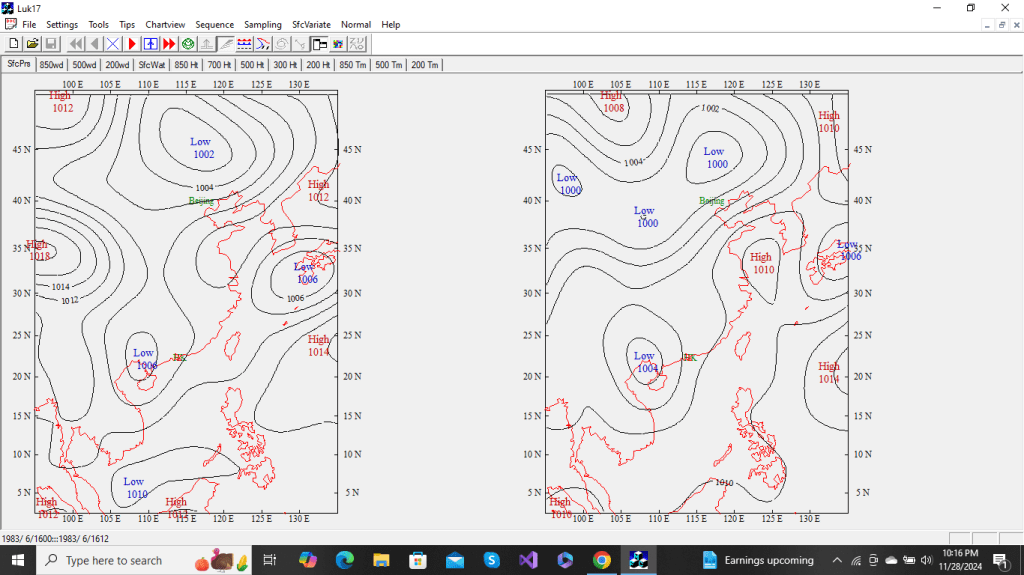
200 hPa streamline comparison
(106.8mm)H+0 case above——————————-(126.7 mm)(example case)
Surface chart comparison
850 hPa streamline comparison
Second example case from same behaviour type for illustration — 101.2mm – 21062800
STANDALONE ANTICYCLONE(3 cases) centred around 25N at Southwest China
First Case: Anticyclone centered West of HK at 27N intensifies/expands eastern extension over southeast China resulting zonal flow reorientation from east-northeasterly to easterly at the South China Coast. (comparable to Type 1a SW China gigantic Anticyclone H+12 which shows a skew asymmetric expansion on the far eastern side of the anticyclone thus resulting an easterly wave like zonal bending feature)
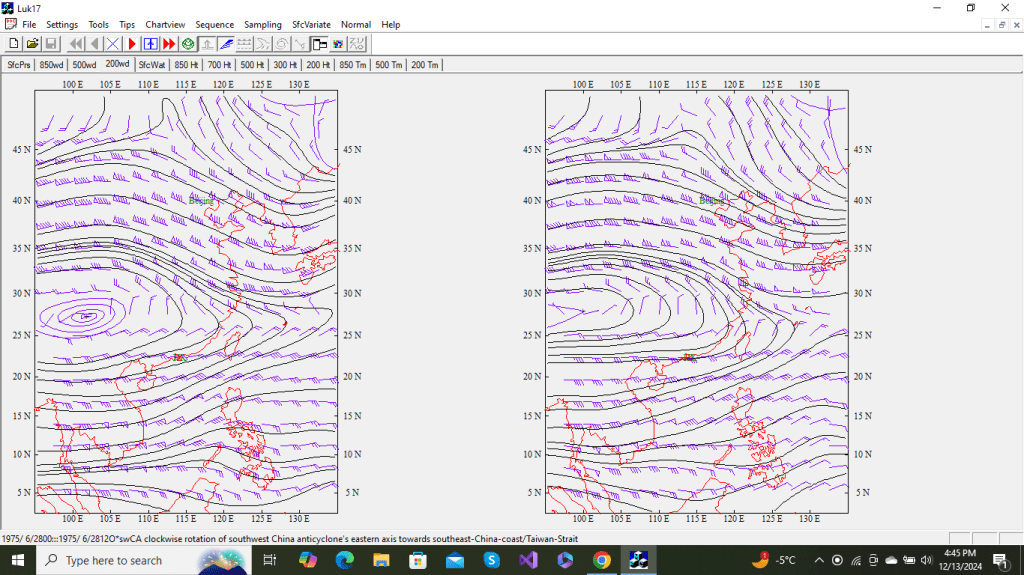
Second case (2 examples):
Anticyclone centered West of HK between 25 and 27N intensifies on base expansion and extends or sharpens-axis towards Hong Kong with/without clockwise/anticlockwise- axis rotation.
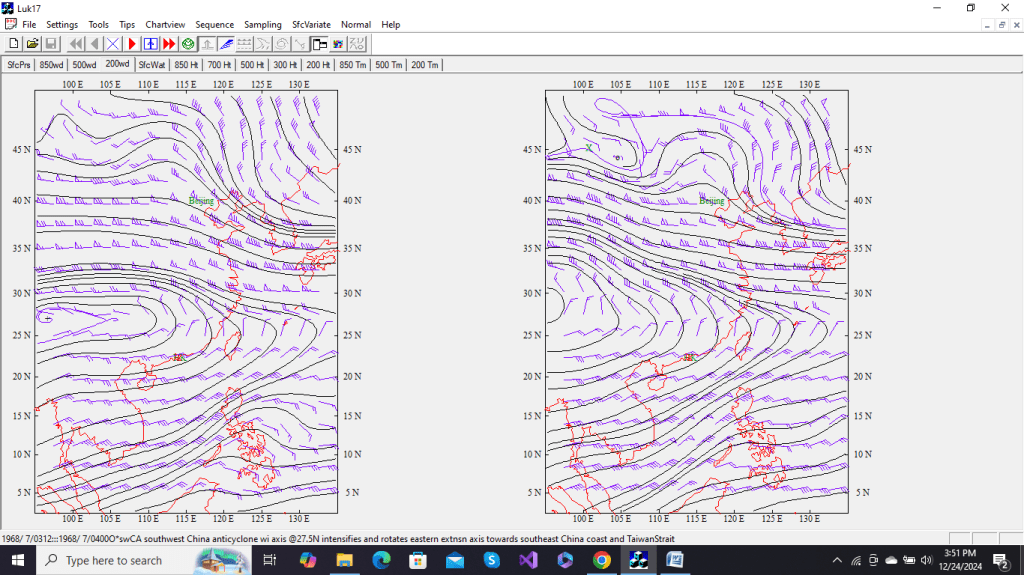
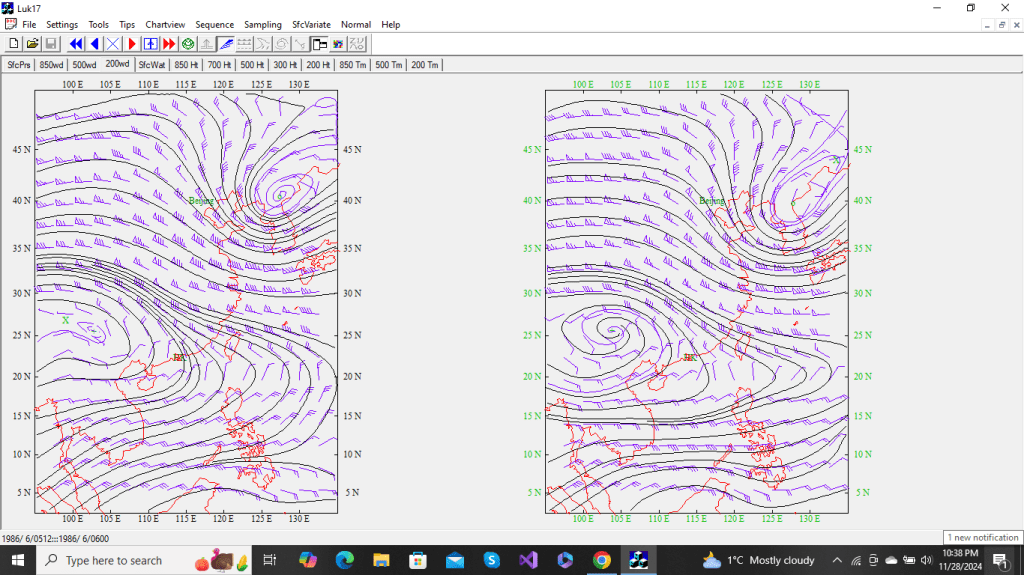
Third case
Anticyclone centered at 26N or close to HK’s north, if either the east or the west segment axis of HK lies on the north row, segment axis on the other side can shift north or south to align.
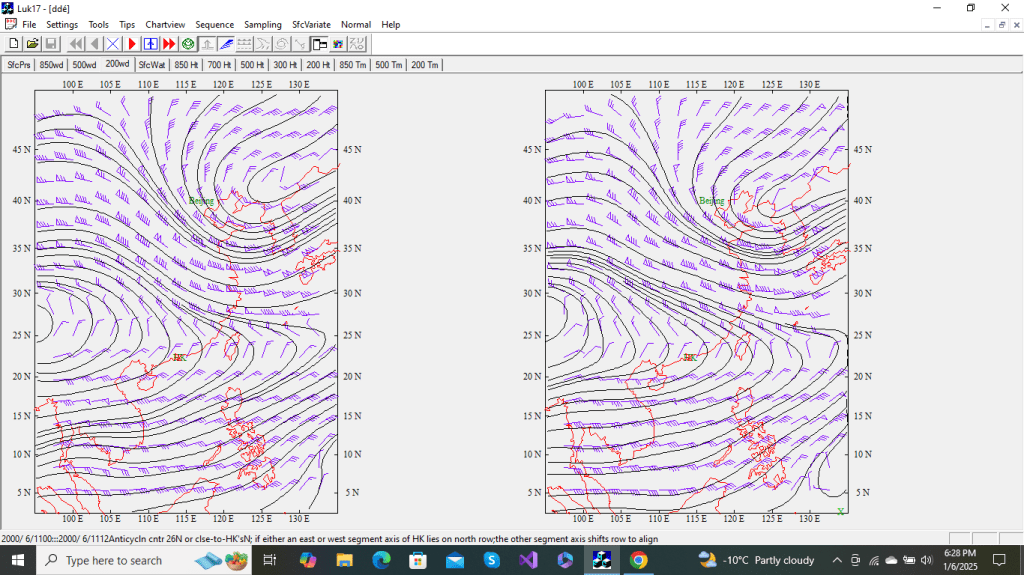
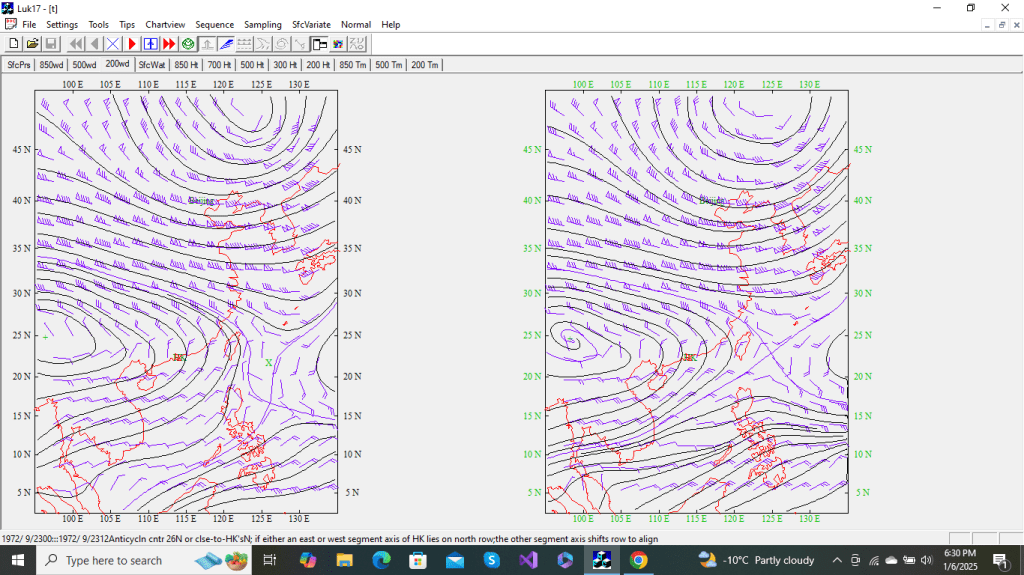
End of Category 3
Virtual behavior category:
The category can be called the ‘why’ category because it raises the question the heavy rain occurrences cannot be answered by behavior at 200 hPa.
Type 1 Virtual behavior – 85.6 mm
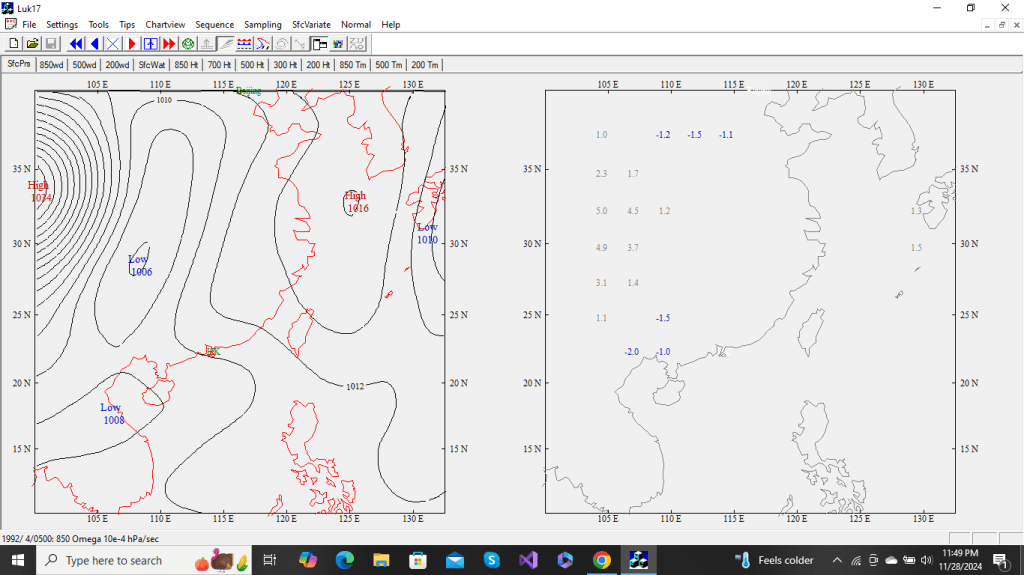
On rare occasions (less than 5), heavy rainstorms occurred in the cool season with no sign of behavior. But they could be detected from the set of two omega charts (vertical velocity at 850 hPa) which forms the first virtual behavior.
(note: On the two 850 hPa streamline charts (not shown here), large scale southerly flow could be observed over west China to the west of HK.)
Chart 1 92040500 at 200hPa, only shallow curvature can be observed from the broad zonal westerly flow over China mainland showing no behavior
92040500
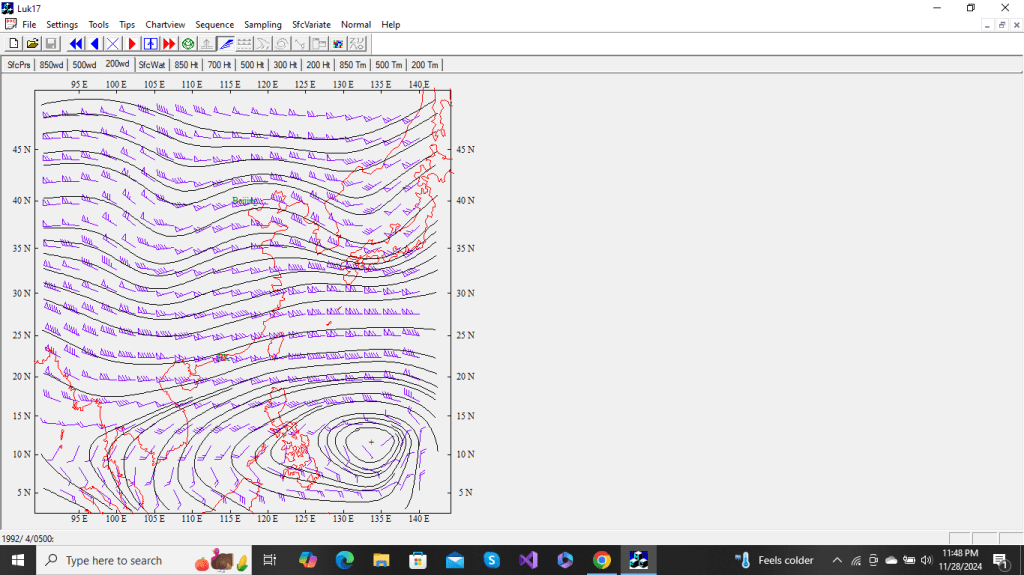
Chart 2: 92040412 850 hPa at T-12 hour active omega activity can be observed over the Hainan Island area
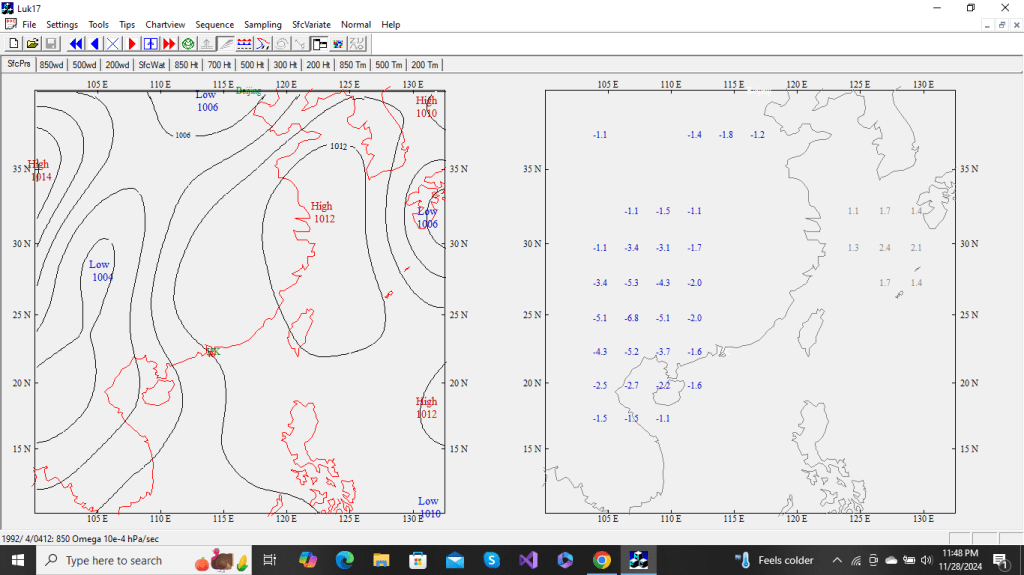
Chart 3: 92040500 Under normal non-rainy situations, the whole bunch of vertical velocity activity would translate eastward over southern China with little change in intensity. But here such activity subsides when it travels to the HK area on the actual 850 hPa at hour+0
Type 2 Virtual behavior – 149.0mm
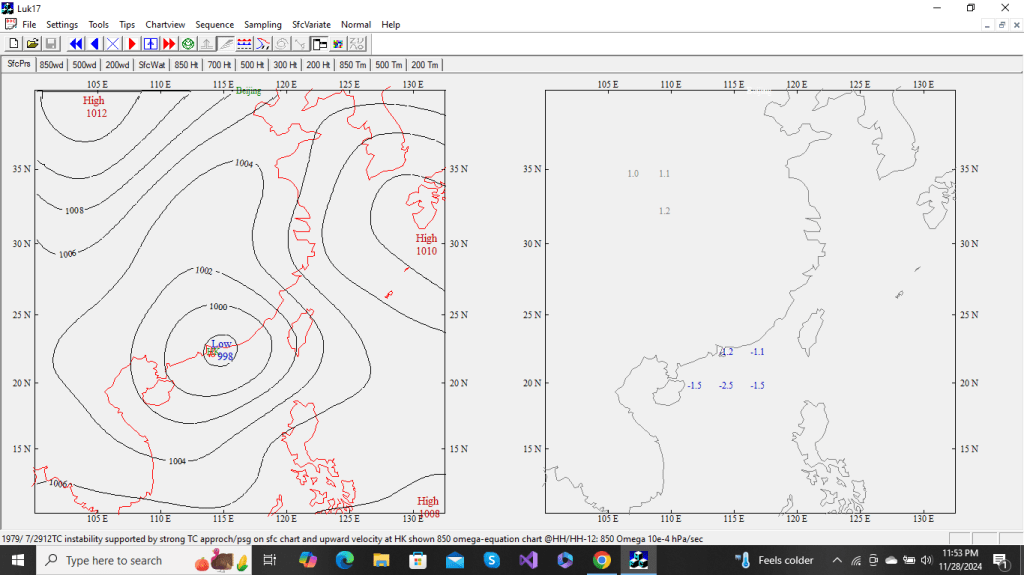
Under 5 occasions, tropical cyclone (of any intensity even low-pressure area applies) close or direct impact to HK, rainstorms with no sign in behavior can occur in summer when it can be detected that on the omega (vertical velocity) chart HK is experiencing upward (negative) vertical velocity, forming the second virtual behavior.
Chart 1 79072912 At 200 hPa despite a large anticyclone to northeast rapidly weakens, no behavior can be observed (the ridge extension from NE is not accepted since it does not make an impact on north row)
79072912
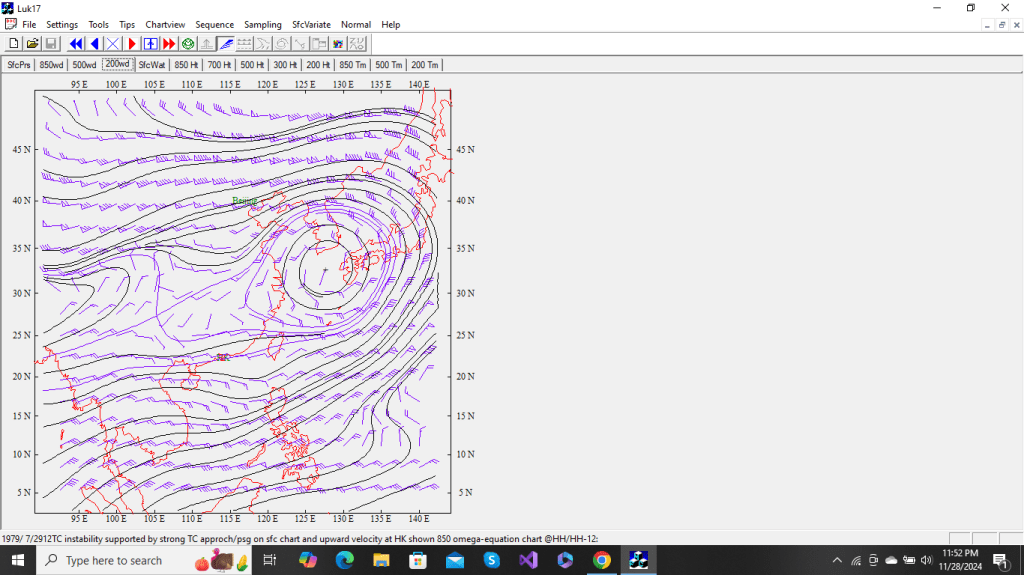
Chart 2 79072912 In the actual 850 hPa at hour+0 omega activity can be observed at HK.
As a word of caution, virtual behavior is neither necessary nor sufficient for general heavy rainstorm detection. Virtual behavior works as a sufficient condition where no real behavior can be found. According to situation Example 3 in the Appendix :VERIFICATION below, virtual behavior only works in heavy rainfall cases only four times in the past. Each time it occurred only in July or August, only for tropical cyclones of equal to or higher than Severe Tropical Storm intensity, and got to be close to a moment of direct impact to HK.
CONCLUSION
After viewing all example cases, the last question is could there be any historical heavy rainfall case where no behavior (neither real nor virtual) was found. The answer is yes. From the very beginning, we have sampled each atmospheric condition at 200 hPa level on a 12-hourly time slice. There are 6 cases when perturbations are either coming late (i.e. fell within the next time slice) or seemingly too far away from Hong Kong to post any threat.
The foregoing discussion has focused on what, where and how to identify behavior from various atmospheric meteorological scenarios on the streamline charts for the practice in weather disturbance detection. The next step is to make a strategic plan to apply this knowledge. First, each behavior-bearing meteorological feature confines its activity to a specific season of the year, so we can narrow down the list of meteorological features to those which prevail in the current season. Secondly, we should focus on analyzing current synoptic scenario for possible close resemblances to known scenarios discussed in the study.
Acknowledgement
I wish to dedicate this thesis to Mr. Peter Peterson for his initiation in the study of 850hPa convergence using the Bellamy Triangle. I would also like to dedicate it in memory of Mr. Ho-Chong Leong for his asking me to share my rudimentary work with other peers in the office, and to Mr. Wing-Cheong Poon for responding to the sharing with the enlightening idea of using 200hPa divergence. Together they paved the way for my study of 200hPa vorticity, which disturbance detection is all about.
Appendix
VERIFICATION
This study only deals with cases in which occurrence of behavior types are associated with historical rainstorms without addressing occurrence of the same behavior type without rainstorm. Thus it is interesting to find out how well the association performs in real life.
The first step is applying a preliminary detection from behavior occurrence in the outside-sample period. The results show, under three different situations, unreasonably high occurrence frequency for certain behavior types is observed compared with those of the inside-sample period.
Situation example 1 (unprecise type definition too easily matched): treat anti-cyclonic cell nearby HK as behavior. Such a definition is not correct because rain-bearing anti-cyclonic cell is not just any cell. We need elaboration to get into the full details about which type of cell. In reality, only a handful of the numerous anti-cyclonic cells occurring at certain particular locations or with side conditions could qualify behavior in those cells. A typical case on such cell follows:
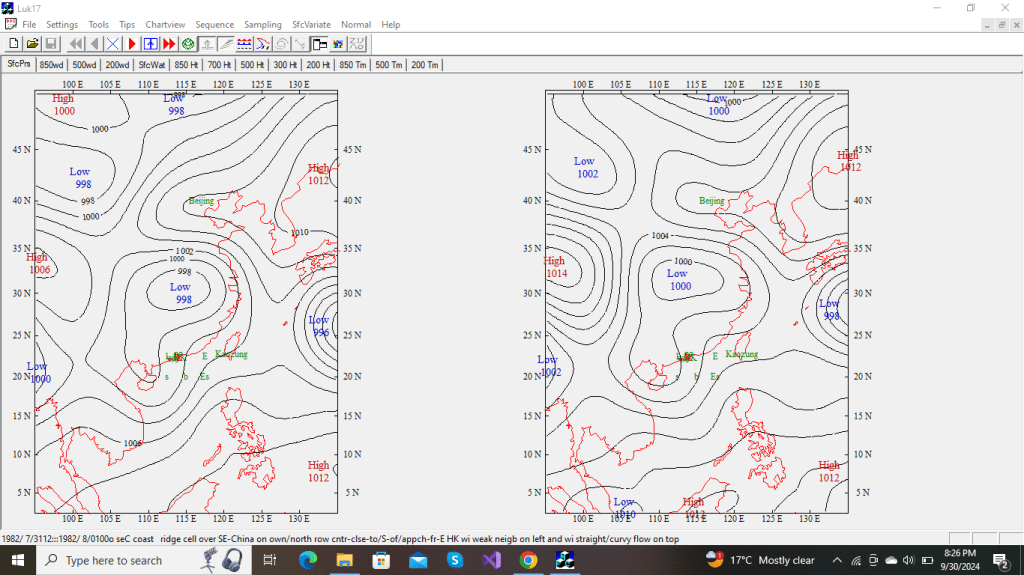
30.5mm (109.1mm) 82080100
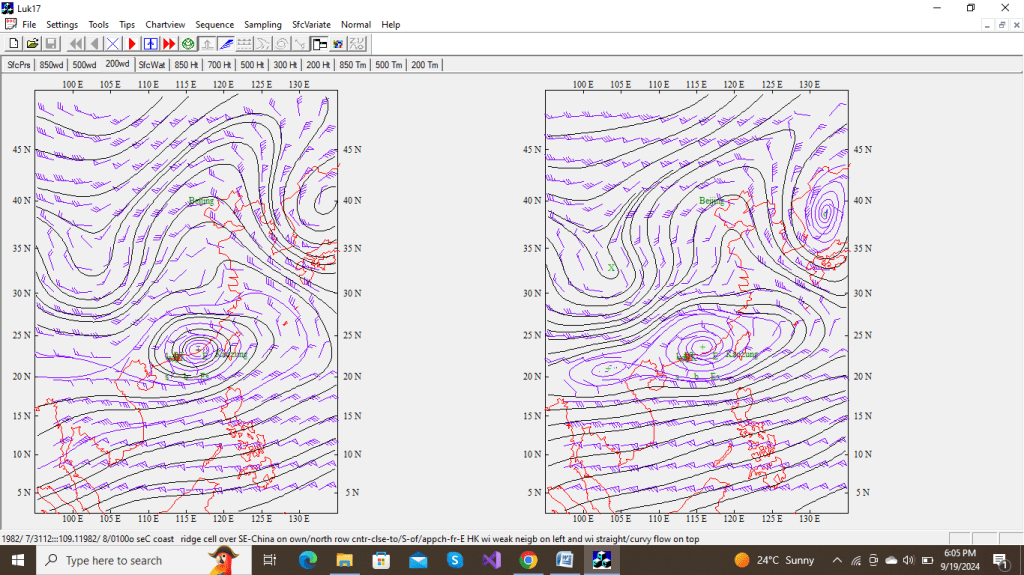
Situation example 2 (secondary instead of primary behavior type selection): row ridge shrinking, axis angle-sharpening or small compact high-cell happening on own row near HK is always the ready pick in behavior type for heavy rainfall occurrence. This behavior is a by-product of more specific (most probably stronger) behavior types. For example, the specific behavior which states ‘HK is at the inflection point between a horizontal trough north of HK and a sharp ridge near HK on own row’ is always a better alternative. Under such circumstances, we were right (that behavior did occur) for a wrong (that of using secondary behavior) reason.
Situation example 3 (indiscriminate assignment to some nonheavy rain situation): in the absence of real behavior, virtual behavior type 2 with low-pressure circulations existing near HK is the accepted behavior. The truth is, virtual behavior applies in heavy rainfall cases only four times in the past. Each time it occurred only in July or August, only for tropical cyclones of equal to or higher than Severe Tropical Storm intensity, and got to be close to a moment of direct impact to HK.
After applying screening for fixing the above-mentioned undesirable cases on preliminary detection, the result is now ready for verification on the background rainfall data. Disturbance detection at 200 hPa is assisted by observation on the water vapor content chart, 850 hPa streamline analysis chart, surface pressure chart and VC++ program generated 850 hPa omega equation chart. (In-house software program is adapted to run on NCAR grid products for any geographical region on earth.)
After applying disturbance detection on 200 hPa streamline charts for the 9-year outside-sample(2013-2021) period without knowing any background rainfall information throughout the process, three main types of errors are identified. The reasons for how each type occurs and the method of reducing it in future are described as follows.
- Mis-identification of non behavior:
The occurrences of a large number of screw-up cases are examined and found to be due to the following reasons: axis position through HK not close, upstream or downstream curvature not comply with inflection, significant ridge-shrinking or curvature-sharpening not present, and in-time curvature changing not observed. It could happen because of inexperience in differentiating between behavior and non-behavior situations since one’s experience is confined to looking at ‘actual’ behavior types only during the model development phase. In addition, misinterpretation can result from neglecting to ensure the presence of some essential features associated with certain behavior. For instance, in the formation of the easterly wave under the ridge to the north or east of HK, the existence of a strong ridge behind the easterly wave’s crest must be a precondition(refer to Category 1 Case 4a redefinition for detail). Similarly, for the passage of numerous mid or high-latitude troughs, only a handful of those troughs each with a strong ridge ahead of the trough’s southeast side can qualify(refer to Category 3 Case 4 redefinition for detail). - Storm of moderate magnitude or ‘weak-parity’ error:
Twelve (12) cases are associated with 12-hourly rainfall of 30 to 49.9 mm.
Eleven (11) cases are associated with 12-hourly rainfall of 50 to 79.9 mm.
There is no clear-cut way to assess the intensity of behavior types appearing before a storm based on direct observation. Hence storms not reaching the threshold intensity could occur. Furthermore, most storms lasting over 2 periods often only sustain the threshold intensity in one of the periods even though associated behavior development is observed and prevails in both periods. Under such circumstances, the period with weaker intensity would end up in a ‘weak-parity’ error. With period rainfall in the 30 to 49.9 mm range, the number of moderate magnitude errors is 9 and the number of weak-parity errors in pre-storm(first) and post-storm(second) periods are 1 and 2 respectively. With period rainfall in the 50 to 79.9 mm range, the number of moderate magnitude errors is 5 and the number of weak-parity errors in pre-storm(first) and post-storm(second) periods are 2 and 4 respectively. - Missing in detection error:
Out of the 38 heavy rainstorms, only 5 cases have their behavior types get identified.
It is a major setback as the theme of this study is on capturing occurrences of extreme rainfall through disturbance detection. One possible explanation for the discouraging performance result might be attributable to trying to verify all cases in one batch without checking, after each detection case, against the rainfall outcome for an explanation of success or failure, but delaying the checking to the end of all detections. In so doing, one cannot learn through the process and gather experience as one moves along. Hence if one performs all detection jobs without immediate validation on each outcome but leaves it until the end, one’s detection experience could be equivalent to staying that of a beginner. Most behavior types have a certain degree of recurring capability in time. If, on the other hand, the result for each date-time checked out is promptly validated, it could contribute useful information towards the successful identification of similar case/s at a later date. - *Based on the new approach, the verification exercise is re-conducted and the statistics on the 12-hourly rainstorms>= 80mm case are composed as follows:
Detection fails in 3 cases of misinterpretation.
Detection fails 15 cases of unfamiliar or new variation within type making it difficult to identify.
Detection succeeds in 8 cases.
Detection succeeds in 12 cases inspired by similar types (mostly of unfamiliar or new variations) which occur earlier in the historical sequence. - *Remarks: verification of the model was carried out in 2021 when it was at an early stage of development. The performance statistics of the model obtained may not reflect the model’s capability level as the up-to-date model now reaches and hence may be ignored.
To illustrate the difficulty in identifying the occurrence of unfamiliar or new variation within type, 2 examples from the outside sample period, and 1 example from within sample period, are presented as follows:
Example one 93.3mm – 16093012(outside sample)
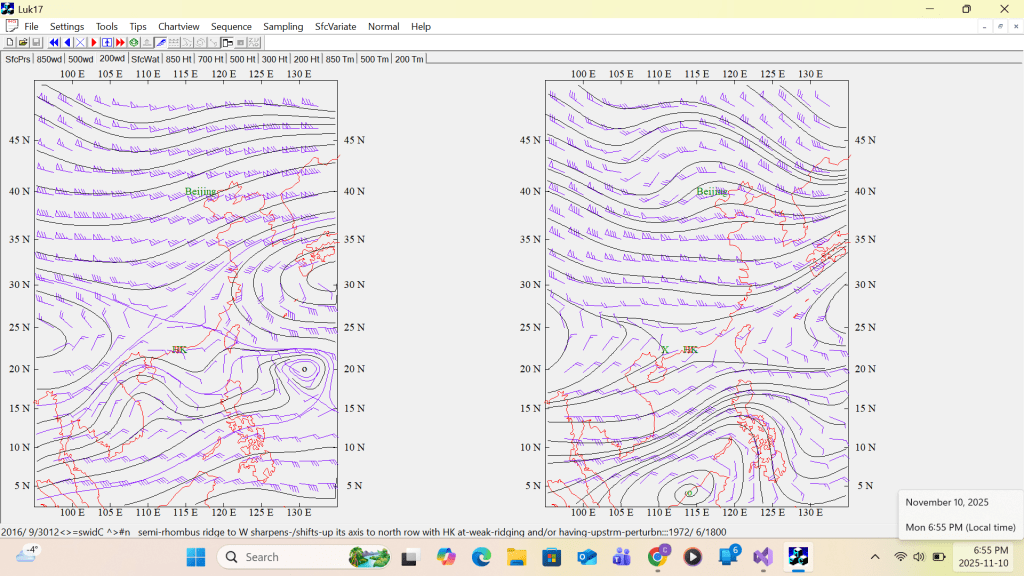
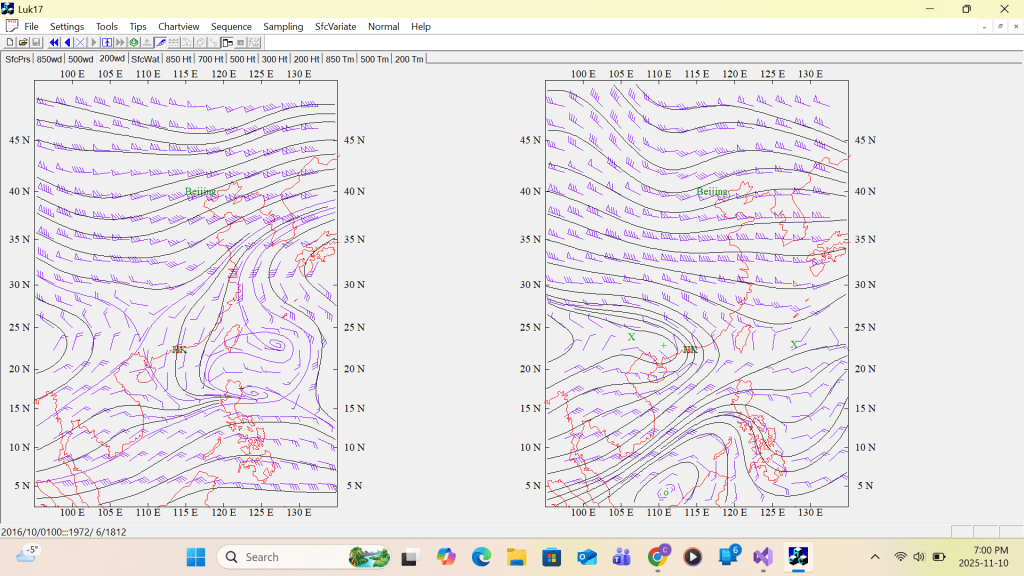
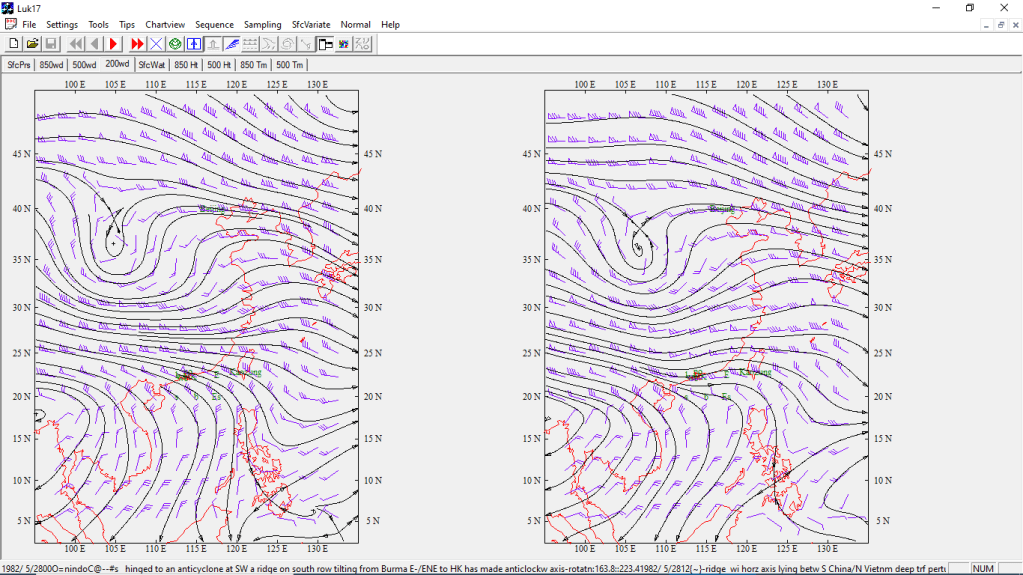
Example two: in the outside-sample period, all (2) perturbations developed within the deep zonal westerlies over the entire region, but in the sample period, all (4) perturbations developed on the northern side of a ridge over Indo-China.
(non-heavy) (124.9mm) 14050812(outside sample)
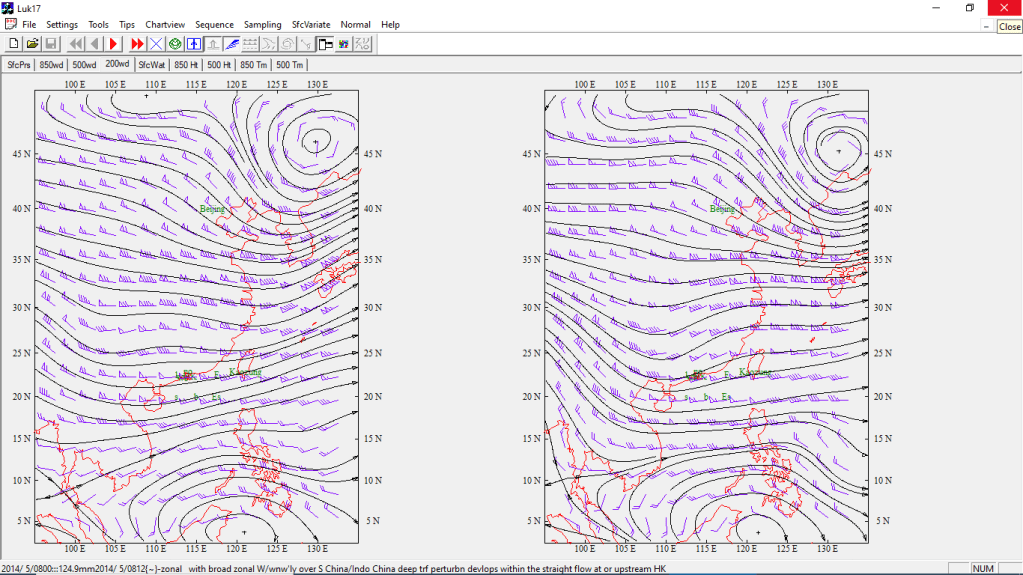
C
ompare to the within sample period case next(163.8mm)(spell case) (223.4mm) 82052812(within sample)
Example 3: 101.5mm – 08062412(variation within type from development period)
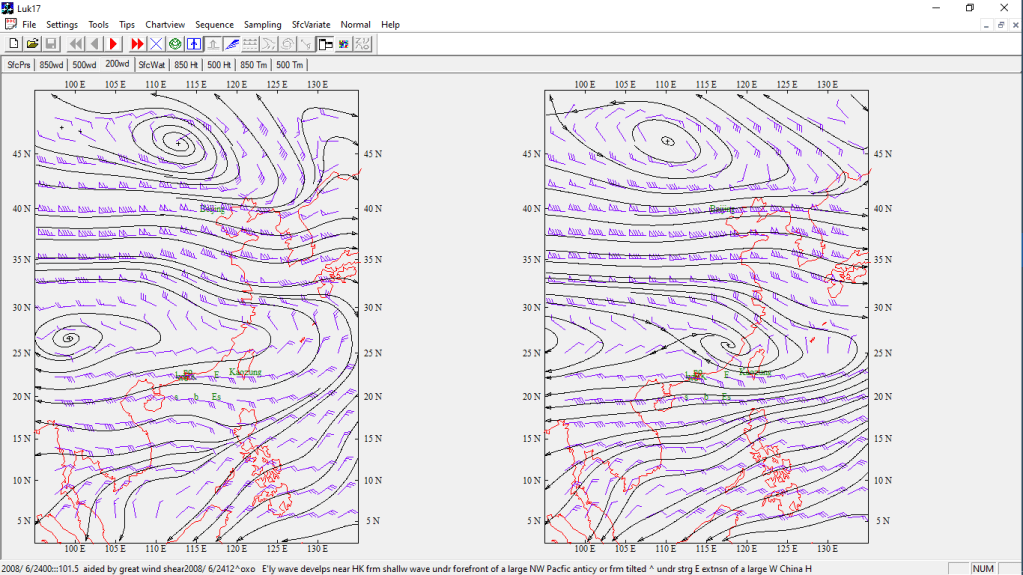
It is interesting to note that there is no new behavior type appearing during the verification data period suggesting that the set of existing behavior types is self-contained. The set of behavior types is composed of 47 types, 3 of which are unique in record of occurrence
 A Study on 200hPa Disturbance Excitation behind a 12-hr Synoptic Scenario for Imminent Extreme Rainstorm Detection in the Subtropical Region